

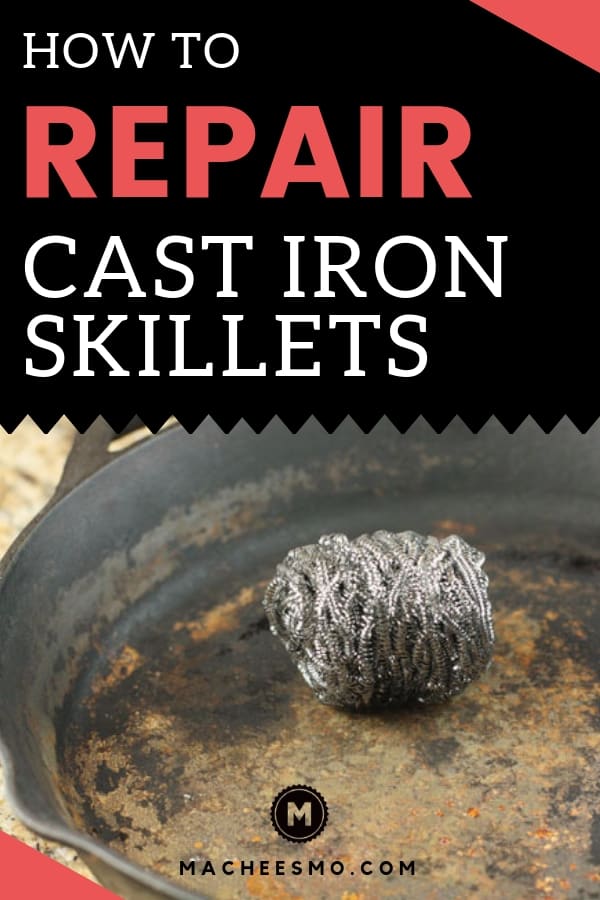
One of the very first pieces of kitchen equipment I purchased with my own money was a cast iron skillet. The above skillet is the same one that I bought almost six years ago. POOR POOR SKILLET!
As you can see, it has seen better days. Generally, if you treat your cast iron skillet well, it won’t get like mine above. But after a few moves and years of use (some improper), mine just got a bit worn. A few months ago I noticed that it was starting to rust pretty badly and by the time I got around to fixing the problem, my skillet was almost entirely rusted out!
Now, some people might say that this means I need a new skillet, but oh no. One of the awesome things about these skillets is that with a little work and a few hours, you can bring it back to almost better than new status.
I figured I’d snap some photos as I went so you can know how to clean a cast iron skillet also.
In fact, if you don’t have a cast iron skillet, you can almost certainly find one at a garage sale if you search around a bit. It’ll probably look as bad if not worse than mine, but with these steps, you can bring it back into good shape.
Cleaning a Cast Iron Skillet
You probably heard it: “Never ever put soap on your cast iron skillet!”
That’s generally good advice because it strips out all the oils that have seasoned the skillet. When we are looking at a skillet like mine though, step one in getting it back into good shape is to very thoroughly clean it.
That means getting off all the rust and crud and basically starting from scratch.
For this, you’re going to want to pick up some steel wool scrubbers!
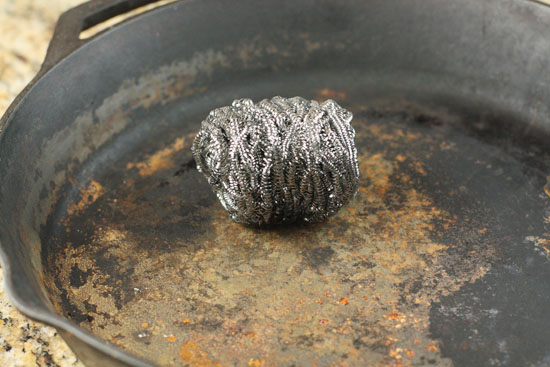
Get some really hot water, a good amount of soap, and a scrubber and really go to town on the skillet. I’m not going to lie, it’s hard work.
You want to make sure you thoroughly scrub all the inside of the skillet. Get the sides and the bottom really well. Make sure all the rust is out. It’s going to take 10-15 minutes of good scrubbing to get the job done.
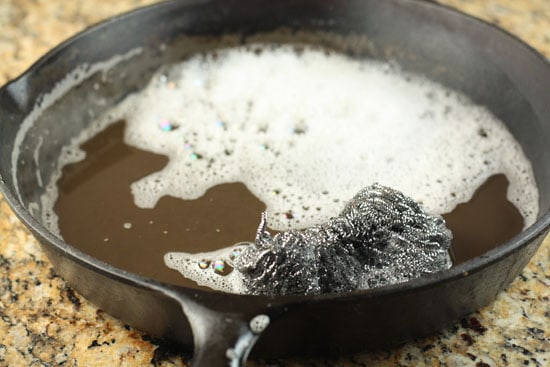
After this, your arms will be exhausted, and you’ll have a nice clean skillet.
This was mine after about 15 minutes of scrubbing. Looking better already!
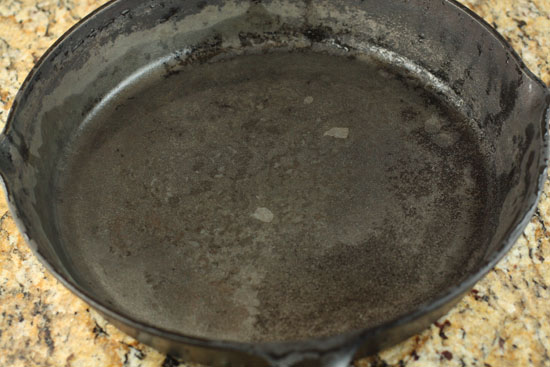
Of course, the problem is that now this skillet is just a big piece of iron with no coating at all to protect stuff from sticking to it. One of the joys of having a good cast iron skillet is that almost nothing sticks to it.
Right now though, this pan is like Velcro. All the little crevices in the iron are going to make anything that touches it stick to it. You can see how it’s kind of a dull black/gray color. That means it’s clean, but not seasoned for cooking.
Seasoning the skillet
Honestly, the hard part is over. Now we just need to get the skillet ready for cooking.
Seasoning, as it’s called, involves cooking a very light layer of fat or oil in the skillet for many hours. As the skillet heats up, the metal expands slightly and the iron basically absorbs the fat. Then as it cools, the oil sticks on the skillet and makes it shiny, smooth, and most importantly non-stick.
You can use vegetable oil for this, but honestly, bacon grease is the best thing for it. So assuming you’re not vegetarian, pull out some good fatty bacon.

Add the bacon to your cast iron skillet and put the skillet on very low heat. After about 20 minutes, most of the fat should have rendered out of the bacon.
You should end up with something like this!
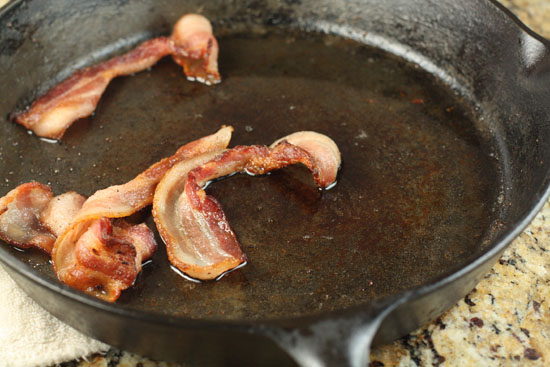
Cleaning a Cast Iron Skillet – Cooking the pan
After you have your bacon grease ready, remove the bacon from the pan, pour off the bacon grease and save it, and wipe the pan really clean. Be sure to get any bacon bits that are stuck to the pan out of there.
Then, using a paper towel, pour a tiny amount of bacon grease back into the pan and rub it around the pan using a paper towel. There should be a very light layer of oil shimmering on the whole skillet. You don’t want any grease pooling in the pan, just a nice smooth layer covering the whole surface.
Heat your oven to 250 degrees and bake the skillet for an hour.
Take it out, rub it with a bit more oil/grease, then back in the oven for an hour.
After two hours, we’re getting somewhere. Notice how the pan is starting to shine a bit.
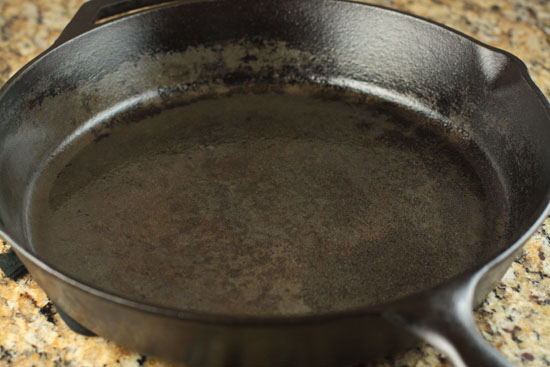
I did this same process two more times.
So in total, I baked my skillet for 4 hours at 250 degrees. Generally, two hours will do the trick, but I like to make sure mine is really nice and seasoned. That might seem like a lot of work, but it’s largely hands off.
When my pan cooled down, I had a nice shiny cast iron skillet that looks a thousand times better than what I started with.
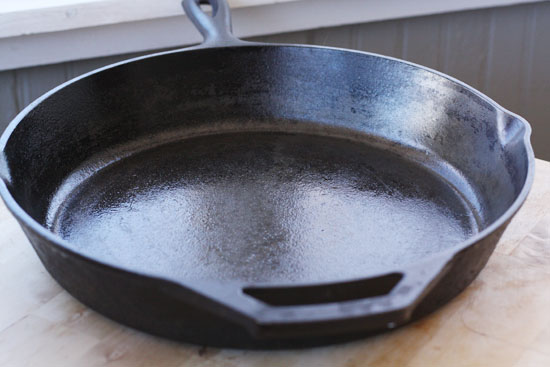
Cleaning a Cast Iron Skillet – The Egg Test
Ok. So the real test for any non-stick surface is a fried egg.
Once you’re ready to test it out, put your skillet over medium high heat and let it get nice and hot. Add a few drops of oil to the pan and crack in an egg. It should slide around and flip easily, just as if it were in a nonstick pan!
I passed my egg test!
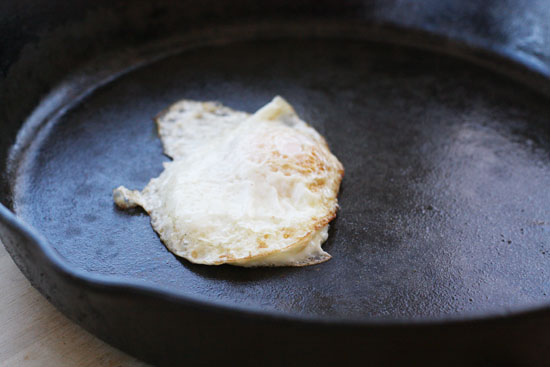
Cast iron skillets aren’t expensive, but there’s no reason to throw one away if you can fix it like new with a few hours of lazy work, and a few minutes of heavy scrubbing.
So, if you have a neglected cast iron skillet or know somebody who does, now you know how to fix it up!
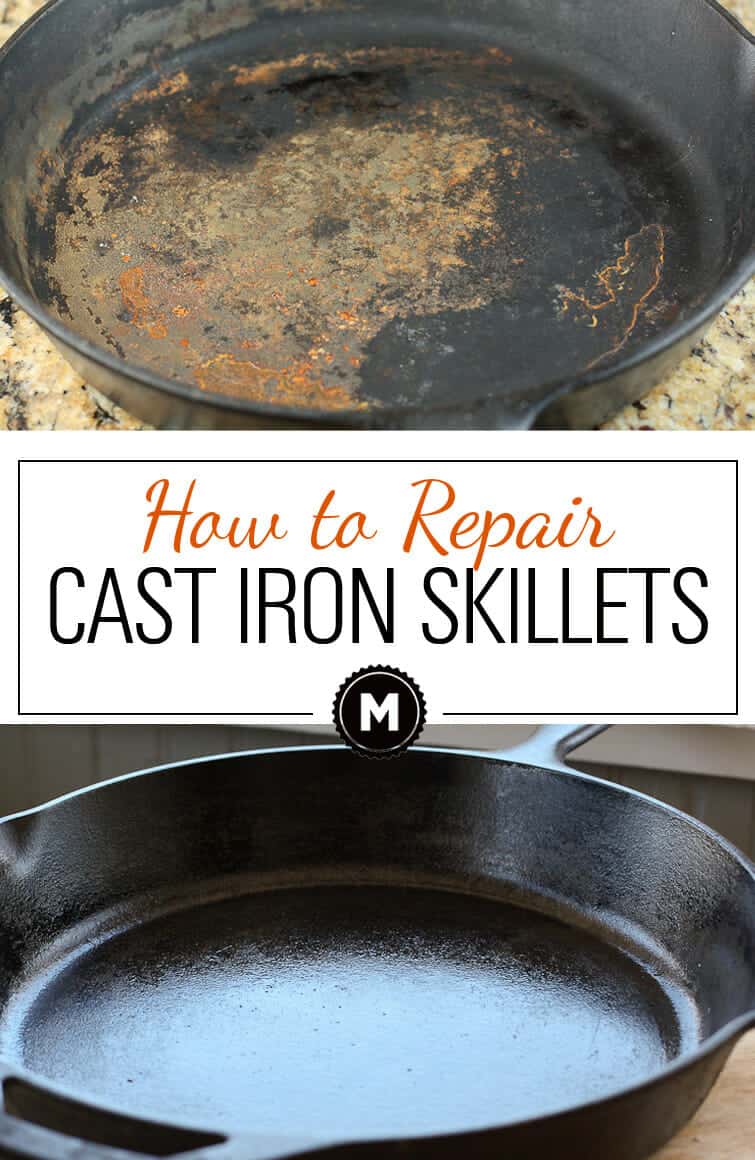
If you have doubts about why you need a cast iron skillet, here are 10 reasons why you should get one.
Jason Sandeman
This used to happen to me all the time back in the day. Some dishwasher would get all up in my stuff, and wash my skillet. Here is another trick if you have some time… and it will help you season your pan faster, and with less scrubbing.
Get some rock salt, the really coarse kind. Lightly scrub your skillet, then dry it. Put it over a medium heat and pour the rock salt into the pan so you have like, an inch on the bottom. Once it is heated up, you can toss it in a hot oven. Every 20 minutes or so, you take out your pan, give the salt a stir, and put it back into the oven.
You will find that the salt will turn greyish-red. (It is lifting the rust out of the pores.) You need to be a little careful, because the salt will be hot.
Then, after an hour of this, you will be able to take your salt out, and scrub with your steel wool on the bottom once it has cooled down.
After, follow the other steps you outlined, then all will rock.
The salt will extract any oils left in the pan, and literally leave nothing in the pores. That way, when you are rendering your bacon fat, the holes will be filled faster, thus making your patina that much quicker.
Hope that helps out man!
Keith
What about using bacon grease I have saved in a jar?
Wiley
IMHO bacon grease is bacon grease is bacon grease! The real difference is getting to eat the bacon!
@papalogic
Hey Nick – great recap on how to restore your skillet. The pictures are great too – like new!
Was this the first time you did this in the six you've done this?
My recent post Baby Says Yum- Nordstrom Basil Tomato Soup
@papalogic
… meant to say: was this the first time you've done this in the six years you've owned it?
My recent post Baby Says Yum- Nordstrom Basil Tomato Soup
Nick
This was the first time it has rusted completely out. I've seasoned my pan maybe once or twice just by coating it with oil and baking it for like 90 minutes. This was the first time I've had to completely repair it though. Worked great though!
Datkari
I have a colleague — for the sake of simplicity, let's just call her MY GRADUATE ADVISOR — who insists that they don't make iron skillets like they used to. She claims that they are pitted in ways they weren't in times past. I pointed out to her that all iron skillets are pitted and that you fill in this pits when you season them and that the difference between skillets she has seen before and new ones are the lack of adequate seasoning. Of course, she is MY GRADUATE ADVISOR and is never wrong. Did I mention I'm looking forward to graduation?
Tammy
Datkari, Your advisor is right.
Not only is the manufacturing process of the pans different, but the iron ore that newer pans are made from is of lesser quality than the pans made prior to the late 1940’s. The older pans were made from iron ore mined from the Great Lakes region and were formed in jeweler’s grade sand molds. Some were even milled to make the inside even smoother.
DutchOvenBetty
Late to the convo. I believe Lodge is the only cast iron still mfg. in the US. All else is mfg in China. And I think I read that Lodge just sold to a foreign company. The grade of cast iron as well as the method used in casting the product does affect the way the product cooks from the griddles to skillets to Dutch ovens. So hang on to you old iron ware and treat it well, you’re not going to be able to replace it.
Lou
FYI: Smithey cast iron skillets are still made by hand in Charleston, SC.
Tammy
This post is making me crave the cornbread my mom used to make when I was younger, baked right in the cast iron skillet. Served hot out of the oven, cut into wedges, and topped with honey butter. So good!
vanillasugarblog
ok i learned something new today. never ever thought to use steel wool. you did a really good job on this one.
want to do mine? mine has the raised grilling lines in it and steel wool is hard to get in there. but i'm just really making excuses. lol
Nick
Ha! Grill lines would make it harder, but still doable.
Mel
Grill lines?? Easy peasy!! Use a fork to hold your steel wool-it will force the wool down between the lines. Works like a dream. AND it saves your nails too!
Irunamuk
Toss it in the fire and burn off all the crud, then reseason and off you go.
Dee
Fine if you don’t mind the possibility of warping.
Farmer
Do NOT toss it into the fire. You run the chance of over heating it in spots and changing the molecular structure of the iron. Once the iron is overheated (1100-1200 degrees) it won’t take seasoning. If you want to burn off the old seasoning, use a gas grill at 550-600 degrees or the self cleaning cycle on your oven. Lye is safer to clean old iron.
eatingwitheick
Whoa. Awesome post. Very educational. I sadly don't have a cast iron skillet, so this seems like a lot of work (I'll just go out and buy a new one) but super interesting to learn the process.
Matt
Pick one up at a garage sale if you're into that sort of thing. Doesn't matter how ugly the cast-iron is, Nick showed how how to make it better than new. Seriously, BETTER than new :)
VCast
We have found several at antique stores. Grizwold and Wagner ware are the best of the older ones.
Dee
Check out your local Goodwill and garage sales, you might luck into a Wagner or Griswold.
Amy Adams
Wow, I had no idea! Presumably, this would work for woks too?
Nick
I think so yea. As long as it is cast iron, probably would work fine.
Dee
Nick here is a less invasive method of removing rust. Go to Walmart and by a plastic tub big enough to hold all the cast iron you wish to refurbish. (I do this in my back yard) Put your cast iron in the tub with enough 1/3 water 2/3 apple cider vinegar and cover. Every day pull the worst piece out and check it out by hosing it down and scrubbing with stiff brush. ((I have had a few “bad boys” that needed a week long soak. When done rinse and scrub with clean water. Immediately do the grease and bake step. I’ve had great success with this and it is easy on arthritic hands. Another hint put some foil on the bottom of your oven and every time you roast or bake pop in a freshly greased skillet (make sure to put skillet on shelf BELOW the food. Saves time and energy.
Mary
I like your idea…will try it in my backyard summertime. My pans are THICK with crud.
Dave
Awesome tutorial!! I'm going to re-season mine this weekend :)
Sweet Pickle
Do you have any advice for how to get rust off of a knife?
My recent post Feta Lamb Bites with Mediterranean Cous Cous
Nick
Hmm… I'd take it to a professional to get it re-sharpened.
Hilary
Excellent post, thank you! I recently saw some vintage cast iron skillets at an antique shop and wondered if they would still be food safe…any suggestions for reseasoning/cleaning or do you think they would be good to go if they're not rusted?
My recent post Apple-Ginger Bread Pudding
Nick
I would re-do them anyway if I didn't know where they came from… just to be on the safe side.
Tony
I've heard bacon grease is good but recently read that flaxseed oil is actually the best. Not sure if anyone has seen this but she insists flaxseed oil is the best for seasoning and backs it up with what sounds like science and a damn sexy picture of a pan seasoned with it. http://sherylcanter.com/wordpress/2010/01/a-scien…
I haven't tried it yet but I plan to this weekend as the seasoning on my pans has been seriously neglected.
Nick
Really interesting! I'll have to try that next time.
Farmer
Do NOT toss it into the fire. You run the chance of over heating it in spots and changing the molecular structure of the iron. Once the iron is overheated (1100-1200 degrees) it won’t take seasoning. If you want to burn off the old seasoning, use a gas grill at 550-600 degrees or the self cleaning cycle on your oven. Lye is safer to clean old iron.
Abbey
Great post! Most advise to bake your greased pan at 400+F which completely smokes out the house, especially if you're using bacon fat.
Here's a question, I actually just noticed that the bottom of my skillet is starting to rust a little bit (probably as a result of not drying it properly and stacking aluminum pots on top of it on the counter). Would you recommend reseasoning the bottom as well or does that not matter? It doesn't seem to be causing any kind of smoke or heating problems during cooking so far.
My recent post Im Okay- the Cheese is Okay
Nick
I don't think the bottom really matters, but I think you could just scrape it off with steel wool so it didn't continue to rust. I'm not sure there's an advantage to seasoning the outside htough.
shalom
The advantage would be to keep it from getting rusty. You don’t need the non-stick surface on the bottom, just enough to prevent rust. I frequently (not every use) check the bottom of the pan to see if it is showing any signs of needing to be seasoned. It will either look very very dull or sometimes it will have a very slight rust color. Since I check the bottom frequently, the rust will be an extremely small amount so I don’t worry about cleaning it off. I just put a very very tiny amount of oil on a paper towel & wipe it on then put it on the burner. I usually dry it on a burner after cleaning it, treat the bottom if it needs it, wipe a thin layer of coconut oil on the inside surface, heat it pretty hot, turn the burner off and let it cool before putting it away.
If I am seasoning the pan in the oven I treat the bottom like I do the inside surface.
raymac
In the booklet that comes with Lodge pans they advise you to wipe it with solid oil, inside and out and then put it in a 350-400 degree oven upside down to prevent pooling for an hour.
connie
when you first season them you are supposed to do the sides and bottom and handle. It helps keep it from rusting
Paul
mmmm bacon.
Regarding cast iron… can you use a cast iron skillet on a glass stove-top?
Non-regarding cast iron… how did the home brew turn out?
Nick
Hmm… I think so, but honestly, I rarely cook on a glass stove-top so not positive on that one.
Haven't tried it yet.. popping it open this weekend!
Doug
My neighbors growing up had a glass stove-top and they used the cast iron frequently. So shouldn't be a problem!
Look forward to hearing about the brew. I have a Scottish Ale in the primary right now.
My recent post Race Report- Patuxent River Trail 10k
Brenda
Yes ,cast iron heats fast ,so less heat ,make sure pan is clean on outside before use.
Jerene
Jerene
I have a glass top stove. I use my cast iron skillet all the time. Just be careful not to bang it against the top.
Jeremy
I use cast iron on a glass topped stove almost daily. No issues whatsoever.
Mikethetuner
As do I. Never a problem. I obviously don’t slide the pan all over the place, but my cast irons all heat nicely on the glass top stove. Not sure why some sources do not recommend it, but with care, it works extremely well!!
Barb
I have a ceramic top and the cast works great!
Marie
Yes, I use my grandmother’s cast iron skillets on my glass top stove all the time. They work just fine.
thefunkykitchen
I got a cast iron skillet for Christmas, I'll have to file this away so I know what to do if it rusts.
Julia Mason
My cast iron skillets always got washed with soap after cooking any thing in them. The trick to doing it is to wash with soapy water, rinse water off and put in rack to drain while I dry my hands. When my hands are dry I then take several paper towels and finish drying the skillet so that no water is left on it. Then a put a small amount of olive oil in the skillet and take a folded paper towel and spread the oil all around inside and out and then store my skillets in their storage place.
Carole Mayon
I Perfect timing. I was just going to Google how to clean rust from my iron skillet. It rust all the time but never new about how to clean and use oil to condition it. Thank You,
Now to work!!!
foodalogue
Wow, great job. I just posted it on FB for my lazy friends and I'm bookmarking it for myself.
Bridget Casas
I have a couple of pans that could use this treatment. Thank you! Oh, can you eat the bacon?
Marie
Of course you can eat the bacon, assuming that you have not over or undercooked it.
phil
Instead of baking in oven, I use my gas grill……No Smoke in the house.
sheila b
great post! I have a cast iron skillet that is just sitting, not being used, for this very reason. Thank you! I will definitely use this treatment to bring my skillet back to its cooking days again.
Tuscan Foodie
Since I moved to the US I am obsessed with cast iron skillets and Dutch Ovens. I found your post while I was researching for my "history of the pan that made America"…
I love these pans.
Mary Ann
Congratulations on the nice mention this posting earned you in yesterday's Washington Post — your blogging fame is definitely spreading!
Justin
I've always done it the hard way, never used steel wool, but I'd use a bit of oil and lots of table salt and my fingertips to scrub out the rust, and then season it accordingly.
Jessica L.
I just got done using this method to repair a cast iron dutch oven…you definitely saved me! I was so sad to see that my dutch oven had rusted, but then I remembered that you posted this and I knew I had to give it a shot. Thanks!
Kat
Ohhh thank you so much for this article. I got my skillet a few years ago and knew I was doing something wrong and was about to throw it away! Thank you!
clueless
Do you use 250 degrees fahrenheit or celcius?
Nick
Fahrenheit. :)
CCarol S
OMG, you ROCK you ROCK you ROCK. I ggled “fix a rusted cast iron skillet” and this page was the FIRST result. And how perfect is that? Got my scrubbers, got my bacon, ready to raise my skillet, Phoenix-like, from the rusticles :)
steve
wow dude,
i followed your directions to the tee… actually i did the suggestion of jason sandeman
using the salt and baking it for an hour, stirring it every 20minutes, and then i did
your step by step… i wish i had taken pictures, like you had. my Lodge 10 in. skillet
is better than when i bought it 2 years ago, and i bought it new and it said it was
already “seasoned”… however, whenever i used it, everything stuck to it and it
was a pain in the butt to clean… i stopped using that cast iron pan approx a year ago
and i was about to throw it away as it was rusted. the other day i “googled” “rusted
cast iron skillet” and your site came up… thank you so much for blogging your cast
iron experience…. i did the “fried egg test” and it was totally non-stick…
Thanks again ,
steve
Nick
Sweet man. Glad you got your pan all fixed up. Definitely one of my favorite kitchen tools once it’s seasoned correctly.
Ryan
I bought a cast iron and thought it was absurd not to wash it with soap. One time I set it in the cupboard and forgot to dry it after I washed it. It rusted, but not as bad as yours. I did the oven thing after it happened, but put the oil layer too thick and it turned into a nightmare of some insanely tough sticky coating. I just scrubbed that out and burned it in on the range, apartment was smokey as all hell but it did the trick.
Now after just scrubbing it out with a plastic brush I usually always set it on a burner to med/high until it starts to smoke and oil it. I’ve only had it for a couple years and the thing looks like it’s been around forever. As black as the void.
rachel smith
thanks for this! I just got a set of cast iron and it was in my cabinet waiting to be seasoned and we had company who cooked rice in one of the sauce pans and then left water sitting in it…uck…now I need to pick up some steel wool…wish it had been one of the skillets not the little sauce pan! I see some raw knuckles in my future from the scrubbing stage….
My mom used to cook with cast iron, that’s why I bought this set…they were great over the campfire (she and my step dad volunteered for the forest service so we traveled from one national forest to another in a school bus turned travel trailer) and I miss it…and now we have a gas stove and oven and I figured it’s not a campfire, but it is an open flame, so I wanted some cast iron for it :)
Natasha
How do you take care of your skillet after each use of it?
Nick
I just rinse it with warm water (no soap) and dry it well with paper towels. That’s it!
Pieter
Hi
I have two very old cast iron kettles I would like to get into a usable state again.
The bottom of the one is extremely thin and the other one has a hairline crack and one hole rusted through, the entire bottom also very thin.
Can I braze to build up the bottom of the kettle?
Any other suggestions, then how can I get the Kettle look nice and black again?
Thanks
Pieter
Nick
Hi Pieter… I doubt that will work. This method only really works for cast iron pans that are thick and you cook on. I think you might just need to splurge for a new kettle. There’s no way I know of to build up the bottom of a kettle.
Brian French
Yes you can braze to build up there bottom of the pan, but you are going to need to pay attention to melting points, such as the melting point of cast iron and there melting point of the material you will use for brazing. Keep the melting point of the brazing material under the melting point of the iron, but above the temperature you would expose the kettle to when cooking. The process of brazing is going to get the iron red hot and it is very likely that if it cools too fast, your kettle will crack along any fault lines in the iron. I seasoned a new pan at 400f years ago and it cracked in half while it was cooling down, so be very careful if you do decide to braze it, and good luck.
Joe
I recently aquired a cast iron skillet that my mom and dad had for many years. They stopped using it several years ago and though the inside is in great shape, the bottom is showing rust. Is there any hope in saving the skillet?
Nick
Should be very saveable Joe! Rust on the outside isn’t that important as long as it’s not rusted through or really thin… You can use a similar technique on the outside that I used in this post. Just scrub the crap out of it with some wire wool to get the rust off, then just rinse it off well and it should be usable. You don’t cook anything on the outside so it doesn’t really need to be treated like the inside.
Alicia
I am in the middle of my cast iron skillet repair process. I combined your tips with a few others, and WOW!!!!! My skillet was rusted out, I thought I was going to have to throw it out. Several people told me that I could fix it, but they were not sure how to do it. Thanks so much for your tips. My skillet already looks completely NEW!!!!!!!!
Diamond
I love this! I just bought two cast iron skillets because my grandma owns one and I love cooking with them. I accidently stuck the first one in the disher washer when I knew better and thought I just had to throw it away and I bought a new one. My new one was looking crappy and I was beginning to think it just wasn’t meant for me to own a cast iron skillet. They defiantly are NOT made the way they used to be. I’m trying this out know and I hope it really works!
Carlos R. Rutishauser
Gentlemen:
We have a Le Creuset 5.5 Qt round French Oven ( Flame Color ), last week the cover or lid crack partially and some of the paint also was gone. We wonder if you know who can repair the same , of couse as you well know the item in question is in cast iron. Maybe need to be weld and paint.
Le Creuset Company does not offer repair service and despite the fact that it was sold as a full lifetime warranty, apparently it would not apply in this case, years back the service and warranty was different.
If not do you know who might sale tids or covers, if not a universal lid in metal ( not necessary cast iron ) that might fit the oven. The lid diameter is 27 1/2 Ctms or 10 3/4 Inch and have a lip, the same can be in metal color.
Your help would be much appreciated!
Nick
Hmm…. that’s a tough one. If Le Creuset won’t honor the warranty you might be out of luck on fixing it. The process in this post definitely won’t work for enameled items.
If it’s just the lid though I wonder if you can just keep using it without issue?
If it’s a huge crack you might need to find a replacement lid though… check salvation armies and thrift stores for a cast iron lid that fits. It doesn’t have to be Le Creuset obviously… just something cast iron.
Good luck!
Mary Krohn
I have a slightly different problem with my frying pans..I.ve used them for baking chicken…maybe that.s why the sides…inside and out, are covered with hard lumpy crud. I,ve tried all your remedies, plus sandpaper., paint scraping tools…but nothing dislodges these layers. Can.t cook omelettes as the black stuff flakes off..looks like pepper. Would love to salvage these nice old pans. Mary
Kristie
Find someone with a sand blasting cabinet. Local mechanic maybe. Once it’s sand blasted then season it with oil as stated above. I’ve done this with many skillets.
Greg Wolf
I had a pits and clumps on a old pan. I didn’t have anything to lose so I got a wire brush for the drill and polished it out until it was smooth then seasoned.
Valerie Kiesel
I’m surprised no one mentioned how my great-grandmother taught me to care for cast iron. After washing the cooking debris out of the skillet with a dishrag, she would rinse it with water, then dry it. Then most importantly it went straight to the stove on a high flame and a little oil or bacon grease was dropped inside & wiped around with a paper towel. I’ve continued to do this with the same skillet that she gave to my mom (and that my mom cared for the same way), and it looks as good today as it did when Gran had it.
Amy
I was at goodwill today. I saw 3 very rusty cast iron pans for $3 a piece. I didn’t know if I could fix them so I Googled right away and your site popped up. So of course I bought them!! :D
I have everything I need on hand already and I can’t wait to get started. But I was curious if chicken fat could work as well as bacon?
What a steal! Now I’ll keep my eyes open at every second hand shop and yard sale I go to.
Martha
Amy – chicken fat should work fine. I keep schmaltz in my fridge but it’s never as abundant as my supply of bacon fat. Any fat should work and people have had success with many kinds. I also season mine on my Cajun-style BBQ/grill with offest heat.
Rob
Excelllent tutorial! Thanks a lot. I’ve collected many skillets and griddles, but never knew how to bring them back to life. My camping trips will be so much better now.
Sandy
THANK YOU, THANK YOU & THANK YOU AGAIN!
This gave life back to my cast iron skillet.
I was so inspired by your pizza recipe – which was wonderful!
Both the restoration & pizza were relatively simple.
I have now used my skillet to fry meatballs without sticking or smelling weird.
I am a happy cooker!
Sarah
I cook with (flat-bottom) cast iron on a glass top stove (not my preference) every day. No problem. I am careful to warm my cookware up first, I keep the stovetop very clean, and I don’t smooth the cast iron around on it. I have some family heirloom cast iron (some belonged to my great-grandfather, born 1863. (I ain’t no spring chicken myself.)
MY QUESTION: I found some old cast iron, really bad shape, rusty, pitted on the outside, inside ok. On the outside, there are raised metal “globs.” I sanded them a little bit, and they are bright, shiny metal. Looks like something (maybe chemical reaction) actually caused the cast iron to bubble up – it’s just a few bumps in a small area on one side. I’m not a metal worker, but I’m going to guess these bumps will have to be ground down. (have to have a smooth exterior for that darn glass top stove). These malformations are maybe 1/16 inch high. What should I use to sand them off? I started off hand-sanding with a sanding block for metal. That’s gonna take a while. Any better suggestion? (I’m thinking power tools).
Has anyone ever heard of the cast iron forming bumps? I can’t imagine what caused it!
Jean
YES, my cast iron dutch oven had developed these bumps. Probably from
not cleaning it real good. I do not know how to get them off.
Holly
Nick, I frequently wipe oil on the bottom of my cast iron pieces when I’m applying it to the inside after use. In my mind, rust on the outside will eventually eat away at the bottom of my pan and I’ll end up with a hole. Well, maybe not in my lifetime but I hope to pass my cast iron down to my daughters and granddaughters someday.
Michael S.
Hi Nick –
I have a Weber Cast Iron Gridle I used with my outdoor Weber gas grill. I left the gridle outside by my grill ( in a compartment below it ) for a bunch of months. I checked it recently – it’s pretty rusty and dirty. Would the tips for cleaning the skillet be pretty similar for me to clean my cast iron gridle? I’d love to use it again to make cheesteaks and burgers. Thanks.
Joan J.
I bought a cute egg-shaped skillet last summer that was labeled ‘already seasoned’ but within months it began to rust. I have been lining it with aluminum foil and using it only in the oven (almost daily).
I was about to retire it when it hit me – google rust repair – and the first site was yours.
Your instructions are clear thorough and almost fun and your proof or after-photo looks amazing.
So I’m trying it tomorrow and I’ll let you know.
Thanks a million
AD
Here’s a silly question.
I forgot my old cast iron griddle on a burner and the seasoning seems to have burned off to the metal; I’ve scrubbed it with fine steel wool and a plastic brush for a while and it seemed to be clean, no stains on a dry paper towel I used to wipe it after washing. However, once I tried to coat it in grease for re-seasoning, it stained the greasy towel black. Washed it again, but the same thing happened.
So, the question: Is that normal or still more scrubbing needed?
Nick
Hmm… not sure. Does it have grates? I’ve never left it on the burner for longer but it might have done some serious damage. It might not be fixable…. :(
AD
No, the surface is perfectly smooth. It didn’t heat enough to turn red or warp, either; the color where the seasoning burned off is fairly close to what another old skillet looked like after being scoured clean of rust.
Nick
Hmm… not sure on that one. Mine definitely doesn’t turn a towel black after seasoning…
AD
More steel wool in my future then, I guess.
Thank you for the quick response, btw.
and if you’re interested, I can post an update after another attempt at scrubbing it clean.
Sarah
MY QUESTION: I found some old cast iron, really bad shape, rusty, pitted on the outside, inside ok. On the outside, there are raised metal “globs.” I sanded them a little bit, and they are bright, shiny metal. Looks like something (maybe chemical reaction) actually caused the cast iron to bubble up – it’s just a few bumps in a small area on one side. I’m not a metal worker, but I’m going to guess these bumps will have to be ground down. (have to have a smooth exterior for that darn glass top stove). These malformations are maybe 1/16 inch high. What should I use to sand them off? I started off hand-sanding with a sanding block for metal. That’s gonna take a while. Any better suggestion? (I’m thinking power tools).
Nick
yea… you would probably need power tools. I’m not sure that I would cook in it honestly unless you can get it really smooth and clean. Sounds like something weird happened to it!
Brian
Is it possible the raised metal globs are from the casting process? If something bumped a cast while it waiting for a pour, the sand could have gotten shifted creating a place for the iron to go that allows the formation of the metal globs. The manufacturer could have opted to sell it as a factory second instead of spending the time to melt it down and cast it again, and yes, CAREFULLY take a grinder to it, do not remove more than you need to, just the metal glob. After removing the glob with a grinder, finish the process by using coarse grit sandpaper and then fine grit, and lastly triple aught (000) steel wool to put a fine finish on it. Then season according to Nick’s advice
Sina
What do you mean by Very Low. I had my stove element set at 1, just one above Low, but not much was happening and it was obvious the bacon would not be fried in 20 minutes. So I began turning the heat up till it was about 3-4. The bacon did fry then, although it also stuck here and there. Is that bad? Do I need to wash it and start all over again?
Sina
I think the bacon I used was not fatty enough causing the bacon to stick. Also, I’m trying to season two pans – a round skillet and and a square griddle. The bacon on the griddle hardly generated any fat and I had to add grease from the skillet.
So to get to the point, it’s a little hard to wipe a pan clean with a paper towel when bacon has stuck to it, so I used the steel wool again under plain running water, wiped pans dry, added drops of bacon grease, rubbed it in with paper towel, and stuck it oven at 250.
By taking steel wool to the pan the second time, did I botched up the seasoning process?
Nick
Sorry Sina… when I say put the heat on very low… I mean on the stove top, not in the oven. Normally, when I mean oven, I’ll give an exact temperature.
Fattier bacon definitely helps because you want to render it down well. It’s okay if it sticks a little bit… at that point the pan isn’t seasoned at all so stuff will stick to it for sure.
Just scrape up any bacon bits that are stuck and proceed with the process. Your goal is just to get enough grease to coat the entire inside of the pan. Then you rub it down and put it in the oven at 250… etc.
If you steel wooled again after baking, you’ll want to bake it again…
Martha
It is not necessary to cook the bacon in the pan you are fixing – I generally do bacon on a flat bacon tray in the microwave for 5-8 minutes depending on thickness and NEVER with a paper towel in there. I get really great crisp bacon and I save every drop of the bacon grease/drippings. I keep it in a can by the stove like cooks have been doing for time immemorial.
I wouldn’t think of cooking bacon in an uncured, unfinished pan – I don’t think it would be very appetizing to eat and what a waste of good bacon!
b-maharet
my next door neighbor, (50’s ish) picks up rusted iron skillets at every yard sale she goes to. She got a 4qt cast iron dutch oven in horrendous shape,(rusted beyond what I thought was salvageable) for 5 bucks. since we’d been discussing repairing damaged iron stuffs ,she came and bragged on her success . she’d scrubbed it with a clean steel wool pad,rinsed it,dried it, & threw it in her fire pit outside! she let it burn there for hours, when the coals were hot, she smooshed it down into the coals & ash. what emerged the next morn was a surprisingly clean & very surprisingly pristine looking iron pot!!( I can’t tell you how bad the rust was, it had eaten bits away!!) we talked about re-seasoning,so the next night she had a fire, she coated it in crisco & did exactly as she’d done before. (IN the fire & ash) she showed me a cast iron dutch oven that looked like it had come of the shelf just now. it looked glossy & new.
Martha
I use my charcoal Cajun-style BBQ pit grill with offset box and chimney to “work” my pans in progress.
David
Thanks for this. I picked up two cast iron pans at a discount shop in town yesterday. They were only $4 a piece. To others they looked like junk. To me a little bit of gold. I had been looking at cast iron pans in the stores here and they start at $50. I followed your instructions and now have two beautiful skillets. Thanks so much!
anna
I have a Lodge cast iron that I got about 6 years ago. I was wondering if you think this is a good brand or not. I had neglected it a few years back so came across your site as I’m in the process of restoring it (thanks for such helpful pics and info). But would love any advice about brands and if that really matters much at all.
Nick
I think Lodge is a good brand. Honestly, any brand should be fine though as long as it’s seasoned correctly. :)
Meister @ The Nervous Cook
You saved my cast-iron skillet this very afternoon, sir! Thank you for this: I can’t wait to make plum upside-down cake in this thing.
justine
my iron dutch oven has survived several deep hard cleaning experiences. now it leaks all across the bottom. is it possible to get it sealed?
Mari
I have the cast iron skillet my Mother received at a wedding gift in 1939…talk about memories! when I got it out today I saw that it was getting a bit of rust on the bottom so Googled “how to repair a rusted cast iron skillet” and got your wonderful info. The skillet is in the oven as I write. Thank you !
dave
Thanks for the instructions on how to bring my old cast iron skillet and pan back to life. They have been passed down through the generations from my grandmother, at least, but due to my ignorance, were tossed on a shelf in the garage for the last 30 or so years. Accidentally stumbling across these rusted out relics and being much wiser, I realized the fine cooking utensils they could be.
I followed your instructions and even though I had to repeat the steps 7 times until no signs of rust were left, it did clean up quite nicely. Thank you.
When it came time to season these now clean and shiny utensils, I followed your instructions once again but instead of using oil for the seasoning agent, I used PAM, the spray-on baking release product. I did repeat the seasoning process 3 times using PAM but the cooking surfaces of these utensils came out looking like shiny black porcelain and they have a better non-stick surface than ANY of today’s modern utensils. Thank you for your expert advice and guidance.
cindy
another tip, if you dont have steel wool….add about 2 tablespoons of salt and oil to pan, then scrub with paper towel.
James at cast iron skillets I like
I’ve only been seriously researching cast iron pans for about a year, and to say the least this is one of the better articles I’ve read on saving cast iron cookware.
Much appreciated!
James
john snow
how to polish out scratches, if cast dutch oven has been cleaned with a mechanical tool and is now no longer black but a shiny scratched surface can it be repaired ?
Nick
Hey John, not sure on that one. If it’s pure cast iron, you should be able to re-season it and get it pretty close to new… If it doesn’t work though, then you may just be in the market for a new one. Good luck!
Scott
I found your article after discovering (rusting away under my kitchen sink cabinet) a set of 3 Lodge cast iron skillets that my parents gave to me about 13 years ago. I did not appreciate them all that much at the time (lesson learned). At first, I was skeptical about whether or not your method for cleaning/reconditioning the cast iron would work, but now I’m sold. I bought some steel wool and scrubbed all of the skillets furiously until every bit of rust was gone. I had some nice cuts of fatty bacon in my fridge, so I cooked three strips of those in the 10.25” skillet for 20 minutes and saved all of the grease for later. I preheated my gas oven to 250 degrees, rubbed the grease all over them (inside and out), “baked” the skillets for an hour, pulled them out after cooling, rubbed on a little more grease, and repeated the process two more times. After the third time baking, the outside of the skillets were a little gummy and sticky, so I baked them for two more hours at 400 degrees (cooling and a little more greasing after the first hour), and they turned out looking like brand new again! They even passed the fried egg test. I used them to cook a scrambled eggs and bacon breakfast this morning – delicious! Thank you for the article and advice.
Nick
Awesome Scott. That’s good stuff. Glad it worked out for you.
Brandi
I did this step by step just as you said but I used olive oil , I didn’t have any bacon and pan is super sticky! Is this bad??
Martha
My only concern is that olive oil has a relatively low smoking point – I would use peanut oil or maybe even coconut oil if you don’t have bacon drippings. Hope you got the stickiness off. It really don’t take long to get your cast iron into cookable state.
Jan Laine
I have a new skillet that I’ve used a few times. It came pre-seasoned and I’ve added to the seasoning process, but I just noticed some red stains, and they don’t look or feel like rust. Is there something else that could cause the pan to turn red–all i have cooked in it are eggs.
Thanks.
Nick
Huh! That’s weird Jan. If it’s not rust I’m not sure what it could be! If it were me, I would probably scrub it off and reseason when you get a chance just to me sure.
Good luck!
Sharon
Thanks for the informatiion on how to repair a cast iron. My uncle use to do this for us years ago but he put the cast irons in a woodburner.
Pauline
I was about to give up on my cast iron pan, when I saw your article. I then quizzed my industrious husband about how he cleaned the pan (Yes, I should be thankful.) and he said he used a BBQ wire brush and soap to clean the thing. Helpy McHelperson does it again. Anyhoodles, I now have a non-stick pan and a husband who knows better. THANK YOU a million times.
Nick
Ha! That’s awesome Pauline. Glad you got it all fixed up. :)
mark
i have many griswold skillets #2-#20 that we use daily never any rust always heat pan slowly we use electric glass top stove or wood cook stove never raise heat above medium after cooking allow pan to cool and wipe with paper towel apply small amount of lard wipe down and hang up pan if food sticks put water in pan boil scrape with square end spatula stainless not junk plastic very little effort needed dump out wipe out apply lard rehang use 120 grit sand paper on rust or finer never use auto sanders grinders etc i collect griswold and that will ruin them the finish inside good pans is smooth as glass on old pans due to the jewelers sand they were cast in lodge logic pans that are rough inside that claim tey are seasoned need to be seasoned when you get them cover bottom with lard put in oven at 200 for 4 hrs mking sure cooking suface always looks wet after five hrs remove dump existig grease wipe down put back in oven on cookie sheet upside down for 1 hr at 350 remove wipe inside with lard on rag immediately let cool wipe down with lard on rag after cool rehang do not use bacon it has meat in it and salt salt removes seasoning once seasoned bacon and salty foods are fine but until seasoned anything salty is anty productive to remove rust and old seasoning rub salt with small amount of water on surface like you are polishing something cast iron pans wernt meant to be used on high heat of modern stove only low to medium if you want to ruin cast iron use higher than medium heat trust me i ruined a #10 griswold from the twentys pretty upsetting high heat only if boiling water
Dscribble
Holy Punctuation Batman!
Brandy
Haha! Yep!
Theresa
I usually take coarse salt and half a lemon and clean my cast iron pan with that before seasoning whenever I think it needs a good cleaning. Am I ruining it with the salt?
Nick
That method works fine also Theresa!
mark
we like cast iron so much that we gave all our other skillets away they truly last a lifetime i have my grand moters #10 griswold my dad had it his whole life and now i have it when im gone my daughter will have people talk about being green now this is truly green 100 yrs and still not in the landfill green and i never new it thats neat
Ricky W
Instead of bacon greese can I use fatback?
Nick
Absolutely! Just be sure to cook it over low heat and start it cold in the pan so the fat slowly renders out. Should work fine!
Scott Kinsey
I’m wondering about using increasingly finer grits of abrasive paper (with a block on the pan bottom) on a pitted pan. I actually use the stuff to sharpen everyday hand tools and knives generally stopping at around 2000 grit. It’s quick and adequate. Of course, with a badly rusted pan I’d think one might start with a fairly coarse grit, say 100 or so. Care to opine? Thanks!
Nick
I think that would probably work. I just use steel wool… It would burn through paper pretty quickly but you could probably get the same result. Good luck!
Martha
But you know what your best secret weapon is? Use the skillet regularly with metal spatulas! As you push the edge on fhe spatula over the surface of the pan, you want to apply some pressure and microplane the surface. Eventually, it should be smooth. Keep it seasoned and fry eggs or whatever you like. It’s incredible!
Scott Kinsey
Thanks!!!
mynee
I have a 100 year old Dutch oven I purchased online it was beautiful, I cooked shrimp and okra gumbo and cooked it a while to thicken it …it kept getting darker and darker till it turned blackish green. Tasted good but we had the residue of the dark color…very eerie…
Bob Norton
That’s what happens when you cook tomatoes or tomato sauce in an iron pot. It’s the acid starting to eat the iron. Looks ugly and isn’t really good for the pot but it won’t hurt you unless you have hemochromatosis.
Donna Johnson
I got out my cast iron grill pan for the first time in years and cooked steaks for dinner las night. It is one of those long ones that fits over 2 burners. It is full of grease and has chunks of burned on fat. Paper towels will take care of the grease, but what is a good way to clean off the burned chunks. They are really stuck on, and I can’ trudge them by scraping with a table knife. An recommendations for a gill pan that is smaller and easier to clean? Thank you.
Martha
I bought two really yukky skillets for $3 each and just recently got to work on them. I first put them in the oven as I did the self-cleaning cycle. They were not much improved but got a tip originating from Ann Heller, long-time food editor and Grande Dame of the Dayton Daily News. She said she uses vinegar to clean out rust. I tried it and followed up with a copper wool scrub. One came clean but the other is still pitted. So I put it on medim-low heat on the stove with a lid and with about a half-inch of vinegar inside. I’ll report back. The one that cleaned up is covered in a thin coating of bacon drippings and is in the 250 degree oven.
Bob Norton
Soak it in lye for a week, neutralize the lye with a vinegar soak, neutralize the vinegar with a washing soda soak (these two soaks only need a few minutes).
Then scrub it down good, right to bare metal, and do a complete reseasoning.
A lot of work but well worth the results.
Jennifer
I just did this with three “vintage” cast iron skillets I bought, except the lye bath was only 24 hours, and then vinegar soak for 6. They looked great after the vinegar – now I’m seasoning, but using the high heat method.
Martha
Well, the clean one – the 12″ skillet is wonderful. I used it successfully to saute onions and cabbage to make a fantastic reproduction of Olive Garden’s Zuppa Toscana but substituting cabbage for the kale in the recipe. So fantastic that it used to make me want to go to Olive Garden! Now that I have it figured out, why bother? LOL.
Olga
What happened with the other one? Did the vinegar help?
Martha
Yes, it helped a lot. It’s just going to take some more work and I hope to get to it soon. It’s possible it won’t clean up but I haven’t found one yet I couldn’t fix. I never would have thought to use vinegar – haven’t seen that tip online but it is a good one.
I wonder if anyone has any great ideas on how to smooth a pebbly finish out sooner than by regular use? The 12″ I got at Aldi is just not smooth enough yet and my recent successful 12″ rehab skillet is just so much more tempting to use!
CW
I have a 28 inch cast iron pan which is not well seasoned – food sticks on it when I cooked. I would like to season it but the problem is I do not have a oven in which to bake the pan. Can I heat it on a gas stove instead?
My concern is I cannot control the temperature when heating over a gas stove? Does it matter? How Long should I heat it?
thank you for any comment/suggestion.
Nick
Hey CW, baking it low and slow is really the best way to ensure an even season over the pan, but if you don’t have access to one I think you could do it. You would want to keep the pan over very low heat. As low as it will go. And if you do it this way I’m not sure that it will really season the sides of the pan. You’ll have to keep wiping the pan down to distribute the fat on the edges and up the sides, but in theory it should work… I would still think that you would need to cook it over very low heat for a few hours to get a good season on it.
GOod luck!
Celi
I just bought a loge skillet and accidentally burned a corn tortilla on it the 1st time I used it. Now it appears that there is red rust marks?
Do I have to go through the long process of scrubbing off the rust ans re-seasoning it?
Dave
I been using crisco for years to season my cast iron.
This bacon method has changed my way.
Spent the day re-seasonong all my pans.
Good stuff!!
Lyn
Hi, Well, I did not think my skillet was in too bad of shape. I was looking forward to this afternoon project. All the rust came off. I fried up the bacon and just finished my 4th hour long bake. Unfortunately, my pan just always remained sticky between every bake. I never did get a nice shine. Hmmmm, maybe my skillet was beyond repair.
Linda
From all I’ve read, you are probably using too much oil when you season and you should NOT use bacon fat for seasoning at all! The salt is a problem along with other issues Flax oil is claimed best by some, google that, I’m going to try it on the ones I’m refurbing now. Maybe crisco or a veg oil.
Suzanne
Thank You I will start using the Steel Wool, Vinegar and Baking Soda.
Yasi
Awesome-thank you for the details-love it!!
GILBERT
I used two coats of veg.oil on a cast iron tortilla warmer, in the oven for an hour each time on 250. After it cooled, I noticed the surface was sticky to the touch. After setting medium heat on the warmer, I put a tortilla on and it immediately got stuck. I turned it over and tortilla became stuck again. What am I doing wrong?
Nick
Hey Gilbert, I’ve never used vegetable oil but my guess is that you have too much oil on the pan. I would apply it and then wipe it down thoroughly with a paper towel to remove almost all of the oil… That’s the only thing I can think of!
Good luck!
Gilbert
I thought I wiped it down enough with a paper towel after each coat. After it cools from warming up the tortilla, I will check to see if the flakes from the tortilla come off easily. If not, it maybe time for a new warmer
Trying to help
too much oil I think, it should look almost dry when you season it with veg oil, also 250 is too cool in my opinion, I use 350. Also turn I also turn my skillets upside down when seasoning. If you have a stick surface you need to strip it down to bare metal again and start fresh. Also warm the piece to 200f before you wipe on the veg oil
Ann
Do i put the grease on the outside as well our just the inside
Deb Hiatt
Thanks for your article. Spend all of last evening working on my pan, but I’m still getting a black residue on the paper towel when I wipe it down. What’d I do wrong?! Thanks again for your help.
Nick
Hey Deb,
You should be able to rinse it with hot water (no soap) and wipe out any residue. If you keep getting a lot of residue (there is always a little bit honestly), then you might be up for a new pan? Good luck!
Brittany
Thanks for the great advice. I just got a couple of my grandma’s old cast iron pans that haven’t been used in years – she didn’t cook much near the end, and I imagine lifting it was difficult with her arthritis. I will absolutely be seasoning mine with bacon fat – I want it to pass the egg test!
Something I’ve heard on other sites that might make the de-rusting process easier is using steel wool and Bartender’s Best Friend. I’ve heard a lot of good things about that cleanser, and plan on picking some up for my stainless steel pots, and my poor neglected cast iron skillets. (Obviously you’d only use Bartender’s Best Friend if you are willing to start the seasoning from scratch like this article describes – otherwise it would be way too strong.)
Nick
Great tip Brittany. I use BBF on all my steel pots and it will definitely work wonders on cast iron as well as long as you are willing to start over. :)
Thanks for the comment!
Martha Hardcastle Guthrie
I always use bacon drippings with no problems at all. And they are free to me.
I would not, however, cook bacon in a icky skillet. That’s a waste. Get a bacon grease keeper and keep it in your kitchen. You don’t have to keep it refrigerated.
Robert
I have quite a bit of cast iron, newer and old. Some of my skillets got cruddy and the Lodge is rough so I am scouring them and sanding to smooth. I noticed that I have some redish or brown spots that I don’t think is rust as it is seasoned. I noticed the photo on here with the bacon cooking looks the same. I would asume that the pans should be silver or black, not sure what this other color is, maybe it’s turning.
Janah
This worked and the egg just slipped out of the pan. now how do I keep it in this condition after cooking on it?
thanks for tips!
Robert
Janah: after use, just wipe clean. I season most of the time on stovetop. Do not use soap. When your oven is on, a layer of oil/shortening and bake withyour cookies, upside down. Just keep building layers of oil.
Lorae
Looks like I threw away a perfectly good, but abused, cast iron skillet a few years ago :( Question: What do you do to the outside to keep it pretty? Same thing??
Nick
Yep! You can absolutely season the outside as well. I tend to not prioritize it on mine, but you can definitely do it to keep them nice and shiny. Good luck!
Deb
SELF CLEANING OVEN..Save money, energy and time..Our ovens need to be cleaned also right? Put all of the cast iron in the oven and set it to the clean cycle. (don’t overload single layer only) Set it and forget it..let them cool then season with coconut oil.(does not get rancid) This method removes everything down to the original cast iron. Works wonders for yard sale cast iron.
Trying to help
Please, please do not put your cast iron pans into a firepit to clean them. Unless the temperature is perfect it is very, I repeat very easy to damage them. When you turn the cast iron a off red color from placing it into a firepit, that isn’t rust. You have actually changed the temper of the cast iron and essentially ruined the piece as it will not season properly again and is likely warped. No sandblasting either!!! Use an electrolysis set-up (google search it, very simple) or a lye soak or over cleaner (same as lye bath basically). I know many people will not see this but I just cringe when I hear about using a firepit to “clean” cast iron!
Johanna
Our CI was accidentally left on an electric stove burner on high and now it has a brownish “stain” in the shape of the electric coils. This is my husband’s favorite griswold so any advice for how to attempt repair is greatly appreciated. Since we are not dealing with burnt on food or rust I am wondering what our next step should be.
Nick
Hey Johanna, if the stain is on the outside it shouldn’t effect much. Otherwise I would take some steel wool to it and scrub the heck out of it. Since it’s already essentially ruined, you probably can’t hurt it more. Scrub it until you get off all the stain and rust like I did in the photos and then reseason it. I would think that should work but it’ll take some TLC to get there probably. Good luck!
Kathy
I have a pre-seasoned new cast iron dutch oven. After a few uses, I’m finding bits of flakes in my food. It looks as if the pre-season is flaking and you can taste the iron in the food. Could the season be scrubbed off and I could start over? I also have an old naturally seasoned skillet that I love… and have had no issues with flakes.
Nick
Heya,
I think you definitely could reseason it but that’s going to be A LOT of work. If you just bought it which is what it sounds like, I would call the company and complain and see if they will send you a replacement. Good luck!
jerry
i have 2, a large 10″ skillet and a dutch oven kinda thing that the lid can be flipped and used as a griddle. Both are well over a hundred years old. Do not know the actual age as they have been passed down through 3 or 4 generations..I love both of these and they make the best food…I think because they were cooked in with love for the family. I recently used my skillet to make a pawn of cornbread and there were a decent amount of grease left in the pan after i removed the bread, so i though i would wipe it around and put it back in the oven awhile it was cooling down and do a mini season,, now the bottom is sticky. What can i do to fix this..this pan in particular has been handed down again and again. With each hand doing the cooking it has acquired the love of family and food seasoned in. And i would love to preserve as much of this as I can…any suggestions to get the stickyness off the bottom? Thanks in advance
Nick
Hey Jerry,
There’s really no reason that the bottom of the skillet needs to be seasoned perfectly. You could honestly use soap on the bottom of the skillet without too much worry I would think. That should cut the grease, but just be careful to only wash the outside with the soap/water so you don’t mess up the seasoning on the cooking surfaces. Good luck!
jerry
I forgot to mention I had left the pan right side up when i placed it back in the oven…i got a lot of it off by just boiling down water and scraping some with a spatula. i did a re season.. and i did cook a pawn of biscuit bread in it today and it came out well…and delicious….but it tried to stick on me…didnt break the crust though..any suggestions??
jamie
I just picked up a cast iron skillet today at a antique store for 2 dollars! I’m going to give it some much needed love tonight and save it!
Mark
Just curious, why not sandblast with a mild abrasives media?
Grandma Rosie
Just got my hands on my Mom’s cast iron 10 inch skillet , a smaller skillet and a griddle. My Mom has been gone for 4 yrs now and these items have been packed away. All have rust. So the work begins. Thanks you for all the advise. Can’t wait to see the finished product……..they items mean so much. I remember her cooking our meals in these skillets growing up. Thanks again!
Ele
Hi Nick! I’m a new reader and I’ve found you while researching about the cast iron skillet. I bought one specifically to make Tarte Tatin, and only after found out how useful it could be. It’s a Lodge but I got it at TJMax and it didn’t say whether or not it had been pre-seasoned, so I followed the instruction from this post of yours (https://www.crunchtimekitchen.com/2010/07/ten-reasons-for-cast-iron/) and used canola oil and baked it. I cooked some Mahi fillets in it and they stack a little bit, so I decided to do the precess for rusted pans and did the bacon thing. It worked like a charm and i immediately try the home fries. None stack :) I still have a couple of questions though.
Exactly, how do you proceed with the pan? You cook in it, then wash it with hot water and scrub without soap, the dry it and spread a little canola oil? And then use it again? And if it get rusted or once in a while, you do the bacon thing as a sort of maintenance? Is that right? The question is… if season it with bacon and cook fries or fish in it, am I supposed to use a different pan when i want to bake a sweet dish in it? Will it taste of fish or bacon? Or it won’t and I can use the same pan? I checked as many comments I could in order not to ask the same question again, but couldn’t find this one. I know this post is hold, but it would be really helpful if you could answer it. Love your blog btw, and found a lot to do with my new cast iron!
Nick
Hey Ele,
I use the pan pretty much like you describe. Once it is seasoned correctly, flavors won’t really stick to it so you can switch from savory to sweet without too much worry. When I’m done cooking it in, I rinse it with hot water well (no soap) and use a scrapper to scrape off any bits and then I wipe it really clean with some paper towels. That’s really all I do! Every once in a awhile I’ll add a bit more oil to it to give it a fresh coat (or just cook some bacon in it for breakfast). Generally, I have to reseason mine completely ever few years also. Good luck!
Michael
I have a griswold skillet with pitting. Is there any way to restore it back without damaging the pan? What causes the pitting besides neglect? Thanks in advance.
Nick
Hey Michael, griswold skillets are nice. As far as I know there isn’t a way to restore a pitted pan. I’m not sure what causes it to pit, but I think it’s usually just years and years os improper care/storage. If the pitting is on the outside or minimal on the inside it’s probably not a big deal. There’s no reason why you couldn’t still use it if it’s seasoned well, but if it’s badly pockmarked it might move from the useful to the display only category… good luck!
Susan
My problem is not rust but I left my skillet on with something in it till all the liquid went away and now I have a strange flat black build up that doesn’t scrape off even with my trusty steel spatula. Do I try the steel wool treatment? Thank you.
Nick
Hey Susan, that’s a bummer. I would give the steel wool a shot because you have nothing to lose. Worst case, you can’t get it off and the pan is garbage. Best case it cleans up just fine and you’ll just have to reseason it. Good luck!
Nikole
Can always put it in the oven on self clean. After a few hours and a wash and scrub you can reseason your pan and use it again. Don’t get rid of it!!!
sysrion
I agree with you. In the old days, people used to use chainmaile to clean their cast iron pots and skillets. There has recently been a resurgence for these types of cleaning products. I bought this one off Amazon and it works great:
http://www.amazon.com/SySrion-cast-iron-Cleaner-Stainless-Steel-Chainmail-Scrubber/dp/B00XMMKPI0/
Thanks for sharing!
Lori
I think my son put my skillet in water when it was hot and there is what I call a island is on the bottom.
Is that fixable?
sheron
I used vinegar on mine – hot – boiled it mixed with some water then used a scraper…also used some soft scrub for the really nasty ones…once skillet is in use, coarse salt is great to clean it!
LAGraham
All that is is carbon. If you have a self-cleaning oven, just invert the pan on the middle rack and leave it there while you run the oven through its cleaning cycle. Afterwards, wipe down with a damp cloth and you should be back to bare metal and ready to re-season – by whatever method you prefer. Personally, I just rub the pan down with Crisco and pop it back into a 350 degree oven for 2 hours – again, inverted so the excess shortning runs off rather than puddling.
Scott
I have been producing my own bacon for some time now so needless to say, my cast iron pan gets frequent use. With absolutely no effort at all, that pan now stays in tip-top shape. There’s a lesson in there somewhere…
Fred Flintstone
I do not have a self cleaning oven, but I do heat my house with a woodstove. My wife and I have a griddle that was so built up with carbon deposits it was like layers of shale and we didn’t use it any more. I threw it in the woodstove when it was hot embers and it cooked it clean, just dust remaining of the buildup. Seasoned the griddle and it is like new. The intense heat might crack or warp inferior metal, so beware, but I took the chance because the griddle was unusable anyway. I have since cleaned up a rectangular griddle this way, too. I notice the casts that I cook tortillas or pancakes on tend to build up carbon more than those which foods are fried or sauteed or meat is cooked in.
Marie
A FEW WORDS OF CAUTION ! The ‘Use & Care’ instructions for my range/oven state that the racks which are stainless steel “must be removed” from the oven while operating in self-clean mode. Although stainless is very durable & the racks would have to be cleaned separately from the oven, the extreme heat generated may & is highly likely to cause the racks to warp. Just saying…….
While I’m here I’d like everyone to know that pitting inside your cast-iron is not a good reason to junk it. I have a very old oval baker that came to me with pitting across the entire bottom on the inside, some of them a good 1/16″ or better deep. A good scrubbing & seasoning is all that was necessary to cook non-stick in this pan, cornbread at that & everyone where I come from knows that a pan that will do that is a keeper. No, the pits will not ever fill in & smooth out in the bottom of the pan but they don’t need to.
Laurine
do you put anything under skillet? Foil?
Marie Nelson
No, you do not put foil in the oven while running the self-clean cycle. As a matter of fact, the Use and Care Manual to my range instructs you to remove the racks and clean by another method as extreme temperatures are reached that can damage even stainless steel racks( which is the material of choice for oven racks) over time.
Hunting.Targ
Carbon will dissolve into alcohol or vinegar. If the pan is that valuable or dear, finding some cheap, strong vodka or acetic acid (stronger than household vinegar, but DON’T GO HIGHER THAN 10%!) could do the trick. Scrubbing (and gloves!) will still be necessary, but these will be far more effective at removing char than soap and water.
Bryan
If you’ve got a self-cleaning oven, put the pan in there and let it roll. At the end of the cycle, everything stuck to the pan – and I mean everything – will be ash. The pan will look pretty rough, but wash it and scrub it with some steel wool to clean it up. Dry it off, and re-season. Good as new.
Mary Margaret Pierce
Did you find that after you got them out of the oven there was a residue? I can’t seem to wipe my clean without rusting them!
kelly
I have never seen a cast iron that couldn’t be restored.The easiest way to repair cast iron… Throw it right into the camp fire next time you have one, leave it overnight to cool. It will be ready to reseason after a quick wipe with paper towel. I only use cast iron in my kitchen, scrounged from yard sales around town. One had so much baked on junk inside and out I thought it was hopeless until I remembered the traditional way to restore the pans. By morning it was absolutely pristine
Vicki
A friend once told me that the best way to clean a “cruddy” iron skillet, is to put it in a bonfire, when one is “happening” in your area. The heat will clean all the crud (much like the “clean” cycle on an over), and your pan will be ready to re-season. Sounds like a plan, to me!
Caro O’Connell
Hi there. Cast iron skillets are the best cooking implements ever. I clean mine with hot H20 and some kosher salt. Cleans like magic.
Scott
sandpaper
Carol
Papertowel stick to pan why?
Lori
your pan sounds like it has residue (old oil) stuck inside I would warm it up and scrub taking it down to 1st time use. Then reseason it. I use Crisco on paper towel wipe it down (use sparsly) put in 350 oven 2 hours let it bake remove it once or twice to re coat with Crisco be careful its very hot put back in and bake the method she uses in this article is what my dad did and I have done it for years. I wouldn’t do it on skillets that come from China or Korea the metal isn’t the same. this happens when a pan is put away with LOTS of oil in and on it then it sets for a while it won’t rust but the excess oil becomes sticky things tend to stick in it too.
Lori
I think 350* is to hot 250 and the 4 hours is best I’d lightly oil it every hour or so. I read on Pintrest Flax seed oil but it must be pure, with no other additives they said health food store refrigerate the oil. Or good ole bacon grease, I oil mine after every use but never use a lot at a time residue or pooling is not your friend.
Denise Marie Perfetto
Don’t uae flaxseed oil. I went on Wagner website, my pans are from Wagner. It says to use Crisco, the solid white stuff. My pans are great now. Give it a try.
Lillian
I have rust and flakiness on the underside of my cast iron. I reasoned the inside which worked great, but what should I do about the outside?
Nick
Lillian, you can repair/season the outside of the pan just like the inside. It’s all the same material. :)
Chelsea
Once your skillet is seasoned, what is the proper way to clean it since you suggest avoiding soap?
sheron
Very coarse salt works great!
Lori
Or a potato
Hunting.Targ
I’d go with the potato – salt promotes corrosion in most metals. Rub it with the cut side of a raw potato, wipe out debris, then rinse with HOT running water. The starch will dissolve and run off almost immediately.
linda
To clean I rinse with hot water wipe dry put a drop or two of oil and store.ready to go
Christy
I found a newer, used cast iron dutch oven, and tried to deep fry chicken right off the bat. It started smoking befor I could even continue cooking. Now there are black scorch marks on bottom half outside, and inside, with dark grey on top half. I have attempted to reclean, and season this and it stinks of burnt rubber with slightest heat. I have NEVER seen this with any of my cast iron pans and am worried its beyond my repair. Any help would be great. I am getting sick of this horrible smell.
Thanks!
Nick
Hey Christy! That sounds pretty bad. I’m not sure what would cause a rubber smell unless it was something the previous owner did… I would say to bust out the steel wool and crust it completely down until it’s a fresh layer and then reseason it from scratch. Unfortunately you’ll probably want to do the inside AND outside as the burning could be on the outside of the pan. After you reseason it, if it is still smelling and smoking then it’s probably trash. Good luck!
Marie
Hi Christy! I know what that is. The pan & it’s lid were waxed to prevent rust, I have one that was prepared in this manner; the wax in question is food grade but not something you want to taste & boy is it ever smelly while it’s burning off. Before you can cook in the utensil the wax must be burned off, scrubbing is not going to effectively remove it. I’m afraid you’re going to have to endure that horrible smell just one more time. To begin, line bottom oven rack with aluminum foil, place pan & lid upside-down in oven on upper rack to allow the wax to drip out/off of the pan & lid. If there is not enough room for both pieces of course you’ll have to do them individually. The next step is VERY IMPORTANT!, turn on the exhaust vent over your stove/oven & if there is a window near-by you may want to open it. Heat your oven to 350 degrees F. Now it’s just a matter of time, how long depends on how much wax is left on the pieces. There is going to be smoke generated as the wax melts off, when the smoking stops you’re done. Now you need to wash the pieces with warm soapy water, rinse well & dry thoroughly then proceed with seasoning.
Jan
Why couldn’t you just do it outside on the grill?
Hunting.Targ
A grill won’t get the metal hot enough to melt/burn off all the wax. Grills are usually calibrated to flame temperature, not the air temperature. When you set an oven to 350, you’re getting 350-degree air around your food & cookware.
Mary Margaret Pierce
Mine are rusting before re-seasoning and I can’t seem to get them clean…tips?
DIANE HOWELL
You might want to try seasoning with Lard. That seems to season the cast Iron better.
My Skillet has a bevel in the middle. It will not sit level, any sugestions.
Tammy
I know how you feel. I just bought new Pioneer Woman cookware that came with a preseasoned cast iron skillet. I just wiped it out to free it from dust and made hamburgers in it. It smoked and stunk something aweful! And talk about turning the meat black and not burning! I cleaned it afterwards and the black just would not come off. I used scrubber sponges until they were black, threw them away and got another. After 4 ruined sponges I used a steel wool pad. Finally the black was gone and when the skillet dried it was nasty grey and some rust. I was gonna throw it away but now gonna try these suggestions…I hope my skillet can be saved!
Susie
I have a Paula Deen dutch oven that did the same. After many uses that faded but the pan sticks. I I decided to put it in the wood stove like i did my old skillets and the results were awful. My old skillets cleaned BEAUTIFULLY, but this thing feels like a Lava rock! The outside turned shades of red and blue. All I can say is that it must be inferior metal. What a waste.
Deborah
I love garage sales. I bought a #12 for $1.00, a Dutch oven with the lid and s canvas zippered cover for$10.00 what a steal. Believe me I’ve had to scrub a couple with steel wool, reseason with oil and my grandmother taught me to use some salt, a paper towel to really get the oil in. I’m going to try the oil and baking. Thanks for the idea. I too got on this site by accident. I’m glad I did. Too much fun it taught me a lesson not to stop reaching out for new ideas using old stuff. I love it. Thanks for sharing……
Lisa
I have a cast iron skillet that food was baked in and leftovers not removed for a couple of days. Now the bottom of the pan is “spotty”. It looks like discoloration spots. How can this be fixed? It is a new skillet that was purchased about 9 months ago but has been used quite often.
Thanks
Nick
Hey Lisa, if the spots won’t come off with a plastic scraper, you probably need to reseason the pan from scratch. Scrub it down with steel wool until it’s fresh and then reseason it like I do in this post. It’ll take a few hours of work, but should do the trick. Good luck!
James
What if your pan is bigger than your oven any suggestions?
Nick
Hey James, since you are just rubbing on a thin layer of the oil you could put a baking sheet under the skillet and tilt it a bit to fit more vertically in your oven. You might have to remove a few racks to get it to fit. If it still doesn’t fit then I’m out of ideas!
Jill
You could also use your gas grill to season/bake a pan.
Matt
I just bought my pan, ‘pre-seasoned’; it obviously needed some additional work. After watching a couple videos, I used Crisco on the inside and outside of the pan – now it’s incredibly sticky. Help!
Also – if one uses soap, won’t the soap get into the pores of the pan when it heats up?
Matt.
Nick
Crisco should work okay but I usually prefer a more natural grease, like bacon fat. Any fat or oil should work though. If it’s sticky, you probably need to apply a more thin layer and bake it longer. Since soap will kill the fat bonds I never soap my skillet unless I’m completely reseasoning it anyway.
Lori
Check out the date on your Crisco sounds old.. Bacon grease is very good but these days people look down on you for suggesting it.
DIANE HOWELL
You need to remember that alot of bacon has sugars in it. That will make you cast Iron sticky. If you can find fresh bacon that will work great.
Nicki
I washed my cast iron skillet, dried it, put on some canola oil, turned it upside down and baked it for one hour at 350 degrees. The skillet came out so sticky. So, I washed it, this time with a stiff brush and a little soap, dried it, added the oil and tried again to bake it for one hour. Now it’s stickier than ever. HELP!
Nick
Hey Nicki… I think the problem is two fold… one, you are baking it at way too hot a temp. 350 will possibly burn the oil rather than infuse it into the pan. In the directions, I recommend 250 degrees F.
Also, I usually bake mine for a total time of four hours. Yes… it’s a long process, but just an hour won’t get you anywhere. Hope that helps!
Sara
Just to let everyone know, when I was little bitty my uncle found 12 assorted sized cast iron skillets in the corner of a barn about to be torn down and rescued them. He asked my Mom to render about a pound of bacon and sieve the fat. Then he used the hose to wash the dust and chunks of dirt off of the skillets and left them to dry outside, upside down (so the water couldn’t pool and cause more rust).
Then he built a large fire, about three foot across and wood stacked about 3 foot high. After the fire settled down to all red and grey embers, he tossed all the pans into the coals. He didn’t let them touch and he tried to make sure they were upside down. (No idea the logic here, folks.)
He left everything alone until the fire burned out and the skillets cooled completely. He washed them all with a metal scrubber and seasoned them all with the bacon fat inside and out.
I would recommend doing this to everyone if you have a way to burn those crusted up skillets, charcoal grill or campfire, give it a go. If that crusty/sticky/smelly skillet is going to be trashed anyway and you have the capability, what is the harm?
Pam
Love cast iron to cook with. I’ve seasoned just as you do for all of them and for some reason, some seem to take better than others. I assume it’s from years of either caring for them correctly or not. I’m always on the look out for barn sales because you can find very old, odd pieces that I would love to know the history and what was made in them from years ago…if only cast iron could talk!
Maggie
wow, great post. I bought my FIRST cast iron skillet yesterday. I guess I’ve already made my first mistake. The first thing I did when I brought it home is I washed it with soap to get rid of some of the dust it had on it from laying around in a store. So, if you recommend to never ever clean it with soap, what do you clean it with between uses? Also, when you buy it brand new, is it already seasoned?
Nick
Hey Maggie! Most skillets come preseasoned these days. For me, after I use my skillet I rinse it thoroughly with very hot water and use a scraper to scrape off any food bits on it. Then I wipe it out with a dry paper towel. That usually does the trick and keeps it in good shape. Some people also like to rub a very tiny amount of veg oil on it in between uses. Good luck!
Lori
I use an old wooden spoon cut it straight across I broke the spoon part some how any way I put about an 1/8 cup of water in it heat it up, and use the spoon to push the food stuff around, then wipe it out with a paper towel. Or when I am cooking the last couple minutes before I remove the food I use the spoon to deglaze the pan put meat on a plate set it aside scrape the bottom with the spoon and wipe out with paper towel. I also wipe the pan with grease and put in the oven. That’s where I have to keep all my pans I use every day. There are plastic scrapers but I forget to turn my pan off and heat up my fingers, so the long handle of the spoon works great I use the heat to my advantage.
Bev
bought a used skillet: cleaned it and found on one quadrant the iron isn’t smooth but has little sharpish bumps. How do I, and what do I use to knock these down level with the bottom of the pan?
Thanks, Bev
Nick
Hey Bev, steel wool is really the best way. If it is super-pockmarked then it might not be salvageable though. Good luck!
Nick
Oh and PS… you don’t have to completely get rid of the bumps. Some skillets have them after years and years and still cook just fine. Just be sure to get off any rust and give it a shot. It might be just fine!
George
I have a box of old cast iron cookware, 30 minutes a pan would take 2 days, what do you think about sand blasting them?
Nick
Hmm… that might work for cleaning, but you would still want to season them by baking them with fat rubbed on. If I were you I would sell the ones I didn’t want as-is and then reseason just the ones I wanted to use. There isn’t really a reason to have that many cast iron pans. A few different sizes is all a normal kitchen needs.
Kaob
You all are doing the hard work and even probably discarding really good pieces. Just stop by Ace Hardware store and get a bottle of rooto drain cleaner (100% lye), then grab a bin with lid and pour in 10 gallons of water, pour in the entire bottle of lye crystals (1 lb) and mix with a stick. Use rubber globes as this solution can burn your skin! Let the skillet set in completely submerged for 1-3 days. The lye bath will remove all grease, old seasoning and crude that has build up over time. Check daily as some are done within a few hrs and some need 3-4 days plus some scrubbing. Once ready just bring it in under hot water and wash it throughly. Lye will wash off completely and gets neutralized by water. Then scrub it as needed and even use soap if you wish. Dry it fast to avoid rust and you can give it a coating with crisco and bake it in oven at 350F for an hr. That it! don’t sweat it! You can keep the lye properly covered for future use for up to a year.
Tressa kindred
i want to try your method of cleaning. My mother in law has a cast iron griddle that when used leaves a horrible chemical taste on food. Also, I think it has build up on it. My question Is how do you dispose of the water and lye mixture?
Nick
Hey Tressa, I’ve never tried the lye method and haven’t heard of others that use it. Lye is pretty toxic and hard to handle and an extra step that you really don’t need to do. If you just scrub the griddle really well as I describe in the post and reseason it, it will probably be fine. Good luck!
Hunting.Targ
After reading the directions, the only safe way to dispose of the lye solution is with 90 more gallons of water down municipal sewer drain (NEVER PUT THIS IN A SEPTIC SYSTEM!) . Neutralizing the mixture is dangerous and not something I would recommend to someone without solid knowledge of either chemistry or HazMat handling. It should also not be put into irrigation or runoff water nor dumped in a field. Lye can poison drinking water and render land infertile.
Beth
Do not use a plastic container to do this as the water will get extremely hot when you add the lye! Also remember to wear gloves and eye protection and always add the lye to the water not the water to the lye.
Kaob
Correction: 5 gallons of water. Add the lye to water and not the other way around!
Cheryl
Hi Nick,
I burned food onto my skillet and had to scrub it down hard. It is becoming more seasoned however I have pitting on the bottom. Do I season the skillet with the pits or try to get rid of them?
Nick
Hey Cheryl, you probably won’t be able to scrub out the pits if they are deep… You can still use the pan for many things with pits if it is seasoned correctly. If it’s causing a lot of issues though, it might be replacement time… Good luck!
cheryl
Thanks I will continue to work on it
Nancy
Hi Nick,
Due to my ignorance, I think I have mishandled my newly bought lodge skillet. It was exposed to high heat on the stove and now has a huge black burnt mark in the pan. Any suggestions how the skillet can be salvaged? Also, I don’t own a oven, how can I season the skillet on stovetop? Thanks!
Nancy
Nick
Hey Nancy, the black burned mark isn’t a huge issue. I imagine you could get it off with steel wool, but you then will definitely need to reseason it. As far as I know you can’t really reseason a pan on the stovetop just because it’s really tough to control the temp. You need many hours at a constant low temperature. Even low on the stovetop would be too hot I think. You could give it a shot but you’d want to keep a really close eye on it. Maybe you have a friend who has an oven that you could borrow for a few hours and repay them a cast iron skillet meal? :)
Nancy
Thanks Nick for your prompt reply. I can try steel wool to remove the burnt marks. Since I can’t season the skillet without an oven, Is it ok to warm up the skillet and apply shortening after each use?
Martha Hardcastle Guthrie
I don’t know where you are in the country, Nancy, but I sometimes season mine in my charcoal smoker/grill.
Nick
That might do the trick Nancy. Probably worth a shot!
Howard moore
the black mark is heat damage it will not effect the usability of the pan if it is seasoned agin
Sasha
Hi Nancy,
I have seasoned my skillets on my gas stove top. Grease the skillet, lowest heat on stove top, keep it on for about an hour. Repeat everyday for about 4-5 days until the skillet is uniformly black and shiny. Works like a charm.
Hope that helps.
Mal Green
I have a pan that has cleaned up OK but where gunk was on the pan the stain is etched into the surface how smart would it be to get some medium emery paper working my way up to a very fine paper and try and remove the blemishes or would it be best just to leave them if nothing else to add a bit of character to an old pan
Nick
Hey Mal! I would say try to cook something simple in the pan and see how it goes. I don’t think the stain is necessarily bad but the only way to know is to try something like an egg in it. If it sticks or affects the food then you’ll want to buff it out (you’ll probably need something like steel wool) and then reseason the pan. Good luck!
Paula
Thanks for the how-to…thought I knew all there was to know about “seasoning” my cast-iron pan, but when I couldn’t remove the black flaky stuff (no rust) that I’ve now learned is carbon deposit, I went in search of a solution and found your website. I’m going to try the inverted pan plan in my self-cleaning oven. Can’t wait! Thanks for the good advice!
Cat M
I have two cast iron tea kettles which we fill with water and keep on our wood burning stoves. They help to get some moisture in the air. They tend to rust both inside and out. I did season the outside at the beginning of the winter and tried doing the inside but did not have too much luck. Any tips you might suggest for seasoning the inside.
Martha
Put about a half teaspoonful of oil in the water and keep an eye on it. You may need to adjust the amount added and how often you add it. Just experiment. You can’t hurt anything. I would suggest mineral oil.
Do you drink from the kettles? You might even be able to use scented oil but that would be another step in the process.
Nick
Hey Cat,
That might be tough… not sure how I would get rust off the inside of a kettle! If you have a metalworking shop somewhere near you, they might be able to open it up and sandblast it, but that might be more expensive than just replacing it. Also, I’m not sure that it’s a huge deal if you are just using it to boil water. I might just leave it. :)
bubbab Mustafa
I’ve sand blasted some natty ones. Then a good seasoning. Nice and happy.
denise
My mom always put her skillets in the woodstove and burn off the rust or just to keep it cleaned up like that every now and then. Her eggs would just slide off the skillet with ease. She always kept it seasoned with a little oil wipe on it with a paper towel
Elaine
I bought an unmarked skillet from ebay that had been cleaned and lightly seasoned. When the skillet arrived it was a light muddy brown color and smelled of metal. Iam afraid to use it because of the smell… should I clean it with soap and water? What do you suggest?
Nick
Hmm… yea… that sounds weird Elaine. I would scrub it down really well and reseason it. Probably be fine!
Keith
I have done a few pieces of cast iron using the self cleaning oven method. Then I put the item in a sink with two gallons of cheap white vinegar. The low pH of the vinegar removes traces of rust. I often scrub with some coarse steel wool while its soaking. Next I have my oven at 380 degrees. I pull the cast iron out of the vinegar, dry it with a cloth towel and give a a very light coat of cheap part animal fat shortening. Back into the oven for an our, upside down so it can drain. I pull it out, wipe it with a cloth and again with a light coat of cheap shortening. After about the third time I have a nice even seasoning on the skillet. I only do the outside of the utensil one time.
Paris Colins
I have an old skillet at home and I thought that I should throw it away. Thank you so much for this article! Now I know that there is a chance to clean my skillet and to use it again! Carlshalton Carpet Cleaners Ltd.
Anita
So so happy to have this how to article. My husband and I are going on a hunt for an old skillet in order to do this, rather than going out and buying a new one. This seems so much more satisfying. Thank you for posting and for adding the great photos.
Dinky
Do you think your tip for cleaning cast iron pots would work on my black iron stove tops? They have burned on grease build up that I cannot scrub off no matter how hard I try.
Nick
Oh gosh… I have no idea on that one. I would look for a stove/appliance specialist in your area and consult them!
Lisa Tompson
I have such iron skittle at home but I was going to throw it away because I thought that I can’t bring it to live. Thanks a lot for this incredible article! Regards!Eden Park Carpet Cleaners Ltd.
Skip
I used a heavy duty oven cleaner and placed pans in separate trash bags and seal for a few days . they just wiped clean with rags or paper towels. then a wash with 2;1 water and water vinegar. rinsed with water wipe dry with paper towels then season with lard.
JM
Hi there
I got a new lodge skillet and didn’t take the paper/plastic off and put in the oven for when I could get to it. I forgot and preheated my oven to cook something else and realized too late I had left it in there. The sticky/gummy stuff on the back of the paper was attached to the cast iron and sort of melted into it. I tried to scrub it off with soap and water, but there is still a spot. I also cooked some sausages in it, and noticed there was a black/sticky material so I soaked for a day in water – huge mistake (should have known better). It left rust marks in my sink which I can’t get out and now the inside looks really funky. Is my best bet to scrub the hell out of it and reseason? What do you recommend?
Thanks!
Hunting.Targ
Hi JM.
You’ve probably moved on by now, but it all depends on exactly what thevpan was wrapped in. If it was wax paper, then try folliwing step 1 of the article, then rinse clean, dry, then fill thebpan halfway with a simple oil (vegetable or Crisco), and heat to medium (have lid and a CO2 extinguisher handy, just in case). Let cool, drain the still-liquid oil off, then perform step 2 (reseasoning).
If it was any kind of plastic, it is unfortunately bryond saving. Plastics when heated to melting tend to smoke or fume, and to get it to melt out would require blowtorch heat, which will damage the metal’s properties. Hope you’re OK now.
Kathy
Well one sure way I was taught to do to the cast iron is every year in the spring when you burn off the part of your garden to put a lettuce bed ( it needs the ash ) once the fire is going place your iron skillet in the fire and go back and get it out once it has cooled. It will burn off any and all crud build up on the inside and the outside wash it and use lard not shortning but lard smear it all over the inside of the skillet making sure to get the sides, place it in the oven on a low heat remove and wip it clean with a rag or paper towel. Repeat one time then smear a little more lard on the inside and put it up.
James
My brother has benn cooking with cast for years. He has several nice skillets. I’ve recently took up cooking in them, too. I found an deep Griswold in a yard under a pile of leafs. That poor thing was completely rusted. With a little research I came up with about everything all of you have posted. I broght that poor thing back to life. It cooks like new.
I used a medium corse steel wool to get the tough rust off and rinsed. Placed it on the middle rack of self clean oven (put a cookie sheet that you don’t use under it on the next shelf below to catch the gunk). I set the cylce for 2 hours. After the cycle has completed let it completely cool. I rinced it off and lightly brushed off the loose material. I put 70/30 vinegar to water in a container large enough to submerge the entire skillet. Left it set for a day. Warning…. too much vinegar will do more damage than good. So be sure to delute. Use gloves on to remove. Rince thoroughly, dry with paper towel and let sit for short time to dry, but not to long. It will start to rust again. Coat the entire skillet with bacon grease or Cristo, place upside down in the oven at 250 degrees for 1.5 hours. (Dont forget the cookie sheet! What doesn’t aborb in the skillet will drip). After the skillet has cooled coat the entire skillet with Cristo, handle too. I repeated the seasoning a few more times after the first.
You would never have known it was buried in a yard for so many years….
James
I apologize for my misspellings. I entered this on a small cell phone.
Lori
you did great!! On the post and the pan…
Linda Sessions
I had a sticky iron skillet from using the wrong oil to season it. I have found the best is grease is lard. I would never cook with lard but it seasons the skillets nicely. I worry about using bacon grease because of the salt and chemicals. Lard may be hard to find but it will keep for a long time if you keep it refrigerated.
Nick
You’re totally right Linda. Lard would be best. It can be a bit tricky to find though these days and I’ve had good luck with bacon grease as long as you render it correctly. Thanks for the suggestion!
Taz
Hi! I found some old Le Creuset cast iron pots (no enamel) at a thrift store that I would like to get seasoned, but they have wooden handles. Do you think I could still put them in the oven at 250?
Scott
The handles are removable, I would think.
Kenna
We bought a four burner gas griddle grill. The griddle is cast iron. My husband did a horrible job cleaning it the last time. I spent two hours scrubbing it with hot water! Salt and baking soda to get the grease off. The re seasoned. Need to go check on it again. Question is, grill is stored outside with a grill cover over it, not a lid. Would humidity cause it to rust also? Wondering what would be the best way to care for this with it being stored outside? Thank You!
Kenna
I meant scrubbed to get the rust off.
Nick
Hey Kenna, yes… moisture will definitely cause it to rust so if that’s the only place you can store it you’ll have to reseason it pretty frequently. :(
Hunting.Targ
Cover the entire grill with a tarp or insulative cover whenever it is cool and dry.
Tracey
We got a cast iron skillet a couple years ago and it is one of the enameled ones…it looks like it is either rusting or the enamel is coming off or both…would it be ok for me to do this to it, to scrub it and reseason it???
Nick
Hey Tracey, this process won’t work for enameled cast iron unfortunately. Enameling cast iron makes it slightly easier to maintain but the bad part is that if the enamel chips is pretty impossible to fix. :(
Donna
I have an old cast iron skillet thats been past down for several generations. The problem is that suddenly I have a large hairline crack that goes all the way thru the pan. I found this out when i poured oil in it to fry chicken. All of a sudden I had oil pouring out the bottom thru the crack. Is there any way to fix this or is it a lost cause?
Nick
Hey Donna,
If it cracks like that it’s done. No way to fix it… time for a new skillet!
Hunting.Targ
Clean all oil off of the pan (Dawn works best) and take it to a blacksmith. You can barter with the Amish or Mennanites, the craft is alive and well with them.
Enrique
The 250 degree with bacon fat method of seasoning works, but it isn’t as good of seasoning as other methods. The best that I have found is to heat the pan in a 200 degree oven, pull it out and wipe it with a very thin layer of Crisco. Stick it in the oven at 350 degrees for about 10 minutes, and pull it out and wipe it out again to remove any fat that has pooled. Now stick it in the oven at 500 degrees for an hour.
The 500 degrees turns the fat into a polymer layer which is what makes it non stick. The 250 degree method works, but the polymerization takes a lot longer to achieve.
Cast iron myths:
http://www.castironcollector.com/myths.php
Myth: Washing a cast iron pan with soap will ruin the seasoning.
True or False?: False, in most cases. A well-seasoned pan will be armored with a reasonably tough, near-plastic layer of polymerized cooking fat and carbon, capable of withstanding cooking temperatures of several hundred degrees. Although normally unnecessary, washing with warm water and regular dishwashing liquid using a non-abrasive pad or scrubber will not materially affect a well-established seasoning. Cast iron pans should not be left submerged in water, however, and certainly should never be put through an automatic dishwasher cycle, regardless of how well-seasoned they are.
Origins: The prevalence of lye as a soap-making ingredient pre-20th Century is a possibility. Also, a very basic initial seasoning may well be removed by a scrubbing with dish soap.
DO NOT CLEAN CAST IRON WITH FIRE
Myth: The best, easiest way to clean build up from a cast iron pan is to burn it off in a fire.
True or False?: False. While fire will indeed typically completely remove build up, intense heat will often damage the pan, either by warping or cracking it, or by potentially altering the molecular structure of the iron, making it irreversibly scaly.
Origins: Most likely from frontier era camp cooks who would have had no other way to refurbish heavily encrusted pans.
Bethany
Hello, Nick!
I received a vintage griswold skillet from a lady who used either lye or electrolysis to strip the pan. She then used a thin layer of Crisco to season it. The pan is already a nice black color.
Like you, I personally would use a natural fat (bacon grease, tallow, real lard) to season my pan. I would NEVER use Crisco, Pam spray, etc. in my kitchen.
I am wondering what I should do to begin using my pan. Should I be concerned about the Crisco getting in the way of the seasoning I want? Should I simply begin with a good scrub with salt and hot water or soap and hot water?
Thanks for any advice you may have!
AJ
Crisco provides a good durable base season once polymerized. Just add to it with what ever fats you normally use.
Jen
Someone gave a cast iron skillet for Christmas once. I didn’t know anything about them, so like I do with every new kitchen utensil I cleaned it before using it… with soap.. I stored it and one day when I see it, it was completely brown. I thought I ruined it, so threw it away :’ ( When I saw in pinterest that I could clean it, I was mad, lol. I threw it away before even using it once.
Gwen
I bought a ten inch Griswold skillet that appears to be nickel or chromium plated. The first time it was washed, the water ran red with rust even though the surface is smooth and a light gray color with so suggestion of rust or pitting. Any explanations? Or, suggestions as to future care?
Gwen
I forgot to add that the skillet was purchased from an antiques dealer
Nick
Hey Gwen, Hmm… I’m not sure about those finishes… so I’m not sure I can be much help. I would google around a bit and see if you can find specific instructions for that brand. I found this page on their page: http://www.griswoldcookware.com/cleaning_%26_care.htm
Good luck!
Buffy
Just a note for those of you concerned about lye, my grandmother made hominy in her cast iron using lye and while it definately removes the seasoning (no there was no black residue in the hominy) it never hurt them; she just reseasoned them afterward with a coating of either bacon grease or lard which she always had on hand. I make cornbread and pineapple upside down cake in mine all the time and it doesn’t stick.
Carey
I put some Crisco into my cast iron skillet to heat before frying and found grease all over my stove. Seems that there is a crack in the skillet. Is there any way to fix it so that it can still be used?
Debbie
I inherited a cast iron pan from my grandma. I really don’t think she ever seasoned it. the question I have, is on the OUTSIDE of the pan, it’s crusty. should I use the same method to try to get the crust off, as recommended for the inside?
Nick
Hey Debbie! Yes. You definitely can. Cast iron skillets are the same material throughout so you can scrub and reseason the outside as well as the inside. When I do mine, I usually do both just because it’s such a process… I just do the whole skillet when I do it! Good luck!
David
I just got several skillets from a man who was moving. They have not done anything with them for some time and have mostly surface rust. I was thinking of using a wire brush on a drill to get it off before doing further cleaning and seasoning.
I will probably season them on my outdoor grill when I get to it.
Susie
I mentioned to another poster how I bought a Paula Deen pre-seasoned Dutch oven that turned everything black and stunk horribly. Anyway, it eventually quit doing that over the years, but it sticks horribly. I put it in the wood stove like I do my other skillets (which turn out beautifully) and this thing looks AWFUL, like a Lava rock. It turned red and blue and is as rough as a cob. I assume it’s cheap made metal and needs trashed for a good brand. Now to my question, which brand is good? Thank you in advance.
Nick
Hey Susie, I’m a big fan of all Lodge cast iron products. They are exceptional and not ridiculously expensive. Another option though is that you can frequently find great, old cast iron skillets at yard sales and stuff and with a little reseasoning and TLC they can be brought back to life!
Strub claude
It take’s me one hour to read all the messages and was very interested because I buy 3 cast iron about 15 years ago and now I know to use them thank you very much. I live in France.
Debbie
I have some cast iron skillets that belonged to my Mom and they were left in a storage shed and are now coated with lint or dust lint, does anyone have a suggestions of getting them back to normal. These pans are almost 70 years old and I want to pass them on to my Granddaughter. Thanks for anyones help.
Debbie
I forgot to check the notify box.
Sharon
After I use my skillet I run hot water and dry it- the rag is always brown- is this normal?
Dorothy
About forty years ago my mother rescued some found cast iron pans by first putting them in her self-cleaning oven through a cleaning cycle. This burned off all of the crud, and they needed very little scrubbing before seasoning. It cleaned the outsides off, too. Worked like a charm.
Nick
Wow! Cool idea Dorothy! Thanks for the tip!
Kate Prather
I’m a bit nervous about the self cleaning oven thing. My pans are Wagners from my Mom. I cleaned it after frying chops. I used the plastic scraper Lodge sells. No soap. Just hot water. I dried as usual and put it on stove for a minute to dry. Then I (dummy) used to much vegetable oil to wipe it out. And, for some reason I thought I think I’ll put it on the outside. Yikes. I put it in the oven on 300 for 2 hours Now I have a pan with runs of oil down the sides. Armagh. What now? Kate Prather
Nick
Hey Kate! I really think you’re probably okay. I’d take some paper towels or a dry, clean rag and wipe it down really well. There shouldn’t be any oil pooling anywhere but a very light shimmer of a coating. If you wanted to even out any streaks, you can add a little more oil and rub it in really well all over. Then I would turn your oven down to like 250 and leave it in for another 2 hours or so! Good luck!
Marie
The dealer at the flea market told me to use a cast iron pan that does not have a ring on the bottom so it sits more flat on a glass top stove.
Jo Hay
When my skillet gets gunky and needs to be cleaned I through it in the campfire (or an open fire) and leave it for at least an hour. All the gunk is burned off and then ready for re-seasoning. Be very careful removing from flame ( let fire burn down) because it is going to be very hot. Works great for me. God bless.
Karen
I cleaned mine like your instructions and when done it was sticky. What went wrong?
Nancy
My cast iron skillet has acquired a sticky residue. I have scrubbed it and reseasoned it twice but is still there. How do I fix this?
suzanne
Hi Nick! I tried to get through all the comments (really I did) but I kept falling asleep. Forgive me if I am being redundant. Throw the most godforsaken cast iron whatever in a self cleaning oven and self clean it. Boom.
Now wash it good using soap & water and a wire brush to get off any resistant flakes of rust. Put the cast iron in a warm oven with a very thin surface of oil on it & heat at 250° for 1 or 2 hours; repeat as desired. Ignore the rust on your rag the first time you wipe it before starting the seasoning process. Rust will not come off on your rag after the first time you season the pan after wiping with oil. Boom again.
Now about that nonsense of taking off the seasoning with soap: does ordinary soap take the seasoning off your Pyrex? No. Only elbow grease will do that. Just heat the cast iron, heat the oil, wipe out, then use.
Nick
Ha! Thanks Suzanne! I’ve never tried the self-cleaning idea but sounds great!
ruth hoak
what about using coconut oil to season your pans
Jan Wood
I have 3 Cast Iron Skillets that I got in the early 1950’s when I got married. We seasoned them in the back yard in a burn barrel and I still use them all the time. I wash them with soap and water if I need to. Then I dry them with a paper towel and put back on a burner on the stove to completely dry them. I have never re-greased them and have had no rusting. I love them, but they are really heavy as I get older. (81 years young) I hope my daughter will keep them when I am gone. She did take one a few years ago, my second largest. As I had 4 sizes.
Ben
Do you mean 250 degrees celcius or Fahrenheit? 250 Celsius might be a too hot?
Nick
Fahrenheit!
Stephanie, One Caring Mom
THANK YOU!!! I absolutely needed this. I’ve had a rusted cast iron skillet for months. I’ve tried using steel wool scrubs but of course I took the “no soap in the cast iron” too literally and never tried to scrub the rust off with soap. Duh! I can’t wait to reseason and start using my skillet again. I’ve missed cooking with it.
Jennifer
My pan is about 40 years old- it was my mother’s back in the day. I steel wooled it but couldn’t get rid of the rust so got 120 grit sandpaper. It did better but now I see a silver color under the black. Is it worth keeping?
Darla R. Welch
A good friend of mine lives out in the country. Once a year he hosts a party with a huge big bonfire at his place. Not everyone even realized it, but he put all their old cast iron skillets into that bonfire every year. The fire burned off all the old burnt-on grease and left them looking great. Weird, but true!
Andrea
Hi, you Q&A is so long great job, I have question, do you season you skillet upside down on the oven?
Nick
Hey Andrea! I didn’t but I have seen that method and it shouldn’t really matter. Good luck!
Andrea
Thank you for your answer, it is just that when you do it upside down the EXTRA fat drops and it burns really bad and I guess that if you do not turn the skillet upside down that extra fat will burn on the skillet….please give me your opinion, love to know.
Nick
Hey Andrea, you shouldn’t really have extra fat. You can wipe out all extra. You just need a very thin layer on the skillet. It shouldn’t drip. if it does you have too much. That said, I never really do the upside down thing, but either way should work!
Jennifer
What if you can’t get the rust off?
Jim Wigglesworth
I have a cast iron skillet that is warped on the bottom and is not flat. I still cook steaks, fry pork chops, chicken n country fried steak. But the pan does cook unevenly. Any way to flatten the bottom? Jim
Nick
Hey Jim, I have a skillet like that also. As far as I know there is no way to re-shape it… but like you said, it’s still usable for many things.
Pauper Parent
You have to heat the oil to the point where it “polymerizes”. Basically, you are creating a plastic coating for the iron. The applications have to be so thin that you think you wiped all of it off, or the reaction will not occur properly. It’s like putting a coat of paint on too thick – better / necessary to do multiple layers. I have seen up to thirty layers on a big king camper’s skillet, but campers do it over the fire, which makes the polymerization occur promptly.
Crisco is the all – time classic. It is made from palm oil. Also, flax seed oil is super expensive, has a ridiculously short shelf life, and real world tests do not show any substantial upside.
Newer cast iron cookware is different in that the makers leave the surface coarse, allegedly to make their pre – seasoning process more effective. Newer cast is also much heavier.
wag-society.org and castironcollector.com are great places to get started with your cast iron knowledge base.
Dedra
Can you please help me.
I am cleaning the outside of my cast iron skillet with a Dremel and it is taking the black coating off. It is striping it all the way to the silver. Is this okay? Have I ruined my skillet
Nick
Hey Dedra! A dremel tool probably took off a lot of the exterior layer. I’m not sure it’s salvageable after that unfortunately. :( Good luck!
Dorothy
I don’t know what will happen to the scoured exterior, but the interior should still be fine.
Tammy
Have skillet that is thoroughly cleaned, but is pitted all over, inside and out. Will seasoning make this pan functional or should I just throw in the towel?
Lisa
Any thoughts on getting the metallic/iron taste from seeping into food made in cast iron?
Roger
So when do you or do you season the handle and the outside of the piece?
Roger
So when do you season the rest of the cookware, outside of the cooking surface?
Same question as before, incorrect email address.
Kelsey
I know this is an old post, but I HAVE to leave a comment of gratitude! I have many, many, MANY not-great memories of scrubbing scrambled eggs from the bottom on my mom’s cast iron skillet growing up. I just never could understand why anyone would intentionally buy cast iron when it was such a pain to clean! I was looking over new non-stick pan sets to replace the cheap broken ones I have, and remembered my mother-in-law have me two old cast iron pans. They were super gross because no one cleaned them properly after using them on a campfire I am guessing. But, scrubbing the smallest one down with a wire brush on a drill (they were that bad and I gave up using my hand very quickly, haha) and seasoning in the oven for 4 hours, my pan just passed the scrambled egg test. I just wiped it out with a clean rag! I am crying happy right now! I am so excited for my other 2 pans to come out of the oven in 4 hours! I didn’t even have to go to the store to get a brand new set of pans. Win!
Janet Durham
Thank you so much! This is so easy to follow and I can’t wait to get my iron skillets back in tip top shape.
RICHARD Lee LEWIS
Thanks I will try this on 3 old cast iron skillets I have.